Dilip Shah Follow me on
Most Recent Articles |
Redevelopment of Pagdi Buildings in Mumbai SuburbsThe tenants living with pagdi system in non-cessed buildings before June 13, 1996, are eligible for new flats whenever their building is redeveloped according to new guidelines introduced by the BMC. In addition, if a tenant has transferred the pagdi system flat in the name of another person after completing the required legal formalities, the new occupant will have equal rights and will be eligible to get accommodation after redevelopment. The new Development Control and Promotion Regulations (DCPR - 2034) now encourages the redevelopment of these pagdi system buildings by offering alluring incentives to landlords on basis of the total area required to rehabilitate the existing tenants. After redevelopment, the tenants shall become the flat owners. Most of such non-cessed buildings are situated in the western/central suburbs and as on the date, many of them are in dilapidated condition. Under the pagdi system, the landlord is the owner of the property but possession of the property lies with tenants who pay minimal rent as these properties are covered under the Rent Control Act. However, it is necessary to identify the eligible tenants to protect their rights and to ensure that they vacate the premises without fear when the building goes in for redevelopment. The new guidelines also stipulate that the landowner should not manipulate the scheme by introducing fictitious tenements to add to his FSI incentives. According to the new DCPR - 2034, whatever the total area the landowner needs to rehabilitate the existing tenants, he will get half of that area in form of additional construction rights to recover the construction cost and his profit. The rules further state that the tenants are entitled to get more area than they currently occupy minimum area will be 300 sq. ft and maximum 1,292 sq. ft free of cost. If their area crosses the maximum cap, the tenant will have to pay construction cost of the additional area to the landowner. The rules also state that if two to five tenanted buildings are amalgamated for joint redevelopment, the Developer will get 60% incentive FSI of the total area required to rehabilitate the existing tenants in form of additional construction rights. The Government has offered additional FSI of up to 70% of the total existing built-up area if more than five tenanted building plots are amalgamated for joint redevelopment. The landowner requires consent of 51% of the total residents to go for redevelopment and must rehabilitate all the existing tenants in the new structure. The new rules dated 4th July, 2019 for redevelopment are already in force. This will ensure that the existing occupants of such buildings get up to 12% additional carpet area in their new flats. Eligible tenants residing before 1996 according to BMC rules of such buildings are entitled to a minimum 300 sq. ft carpet area, according to the regulations in existence. For more area beyond 12%, the tenants need to negotiate with Developers in consultation with the landowners. In case of old housing societies, the new regulations have offered an incentive to a builder undertaking redevelopment. This is in the form of a 15% concession while paying premium to the BMC for the additional FSI utilized. For instance, if the Developer was paying to the BMC for additional FSI-TDR 1, now he will pay only for 85% of the total quantum of FSI-TDR. This incentive makes the redevelopment project slightly more viable for the Developer. After rehabilitating the existing residents, the Developer utilizes the additional FSI to construct more flats for sale to recover expenses and make a profit. The new regulation further says that if societies had paid a premium on the staircase and lift lobby areas when they were constructed, they need not pay it again during redevelopment. The Developer will get this benefit only if he is reaccommodating the existing residents. The Section 33 (7)(A) and 33 (7)(B) of DCPR - 2034 deals with these subjects. The government’s move is aimed at boosting such redevelopment of residential properties in the city. Many of these are in dilapidated condition, but their redevelopment has been stuck for years. Civic officials stated the attractive incentives make redevelopment a win-win situation for everyone as residents stand to get bigger houses and landlords/Developers would be encouraged to go in for projects in order to make good profits. A town planner said the incentives will help to generate more housing stock in the city and provide more open spaces and amenities and also assist in controlling rising prices of housing stock. A senior civic official said, “In case of tenanted buildings, the earlier regulations had offered 50% additional FSI. But according to the new regulations, a single building will get 50% incentive, if two to five buildings come together for joint redevelopment, they will get 60% additional FSI, and if there are more than five buildings, the incentive will be 70%.” The official added, “Many old housing societies constructed more than three decades ago are in bad condition. Concessions for such societies will attract developers.” The BMC estimates it will lose Rs.600 crore every year as per the new formula for sharing FSI revenue. While earlier 66% of Fungible FSI premium revenue went to BMC and 34% to the State, the new regulations call for a 50:50 ratio. The additional FSI premium revenue was earlier shared equally between BMC and state. It will now be divided so that BMC, State Govt., MSRDC (a State Govt. Body) and Dharavi Redevelopment Project (associated with the State Government) get a 25% share each.
AS PER DCPR - 2034 Sanctioned as proposed with following modification. Sub Regulation 33(7)(A)(a) is modified as below. In case of the plot consisting of only tenant occupied building, the FSI shall be equal to FSI required for rehabilitation of existing lawful tenant plus 50% incentive FSI and the occupier shall be eligible for 5% additional rehab carpet area. New proviso is added in Sub-Regulation 33(7)(A)(b) provided further that in case of composite redevelopment undertaken asmention in (a) & (b) above for two or more but not more than five plots of tenant occupied buildings the incentive FSI shall be 60% & the occupier shall be eligible for 8% additional rehab carpet area and for plots six or more then incentive shall be 70% and the occupier shall be eligible for 12% additional rehab carpet area. Clause 3 in Appendix is modified to the effect that each tenant shall be rehabilitated and given the carpet area occupied by him for residential purpose in the old building subject to the minimum fixed carpet area of 27.88 sq. m (300 sq. ft) and/or maximum carpet area up 120 sq. mtrs. (1292 sq. ft.) free of cost. In case of non-residential occupier, the area to be given free of cost in the reconstructed building shall be equivalent to the area occupied in the old building. Provided that if carpet area for residential purpose exceeds 120 sq. mtrs. (1292 sq. ft.) the cost of construction shall be paid by tenant to the Developer. The cost of construction shall be as per ready reckoner rate of that year. However, the carpet area exceeding 120 sq. mtrs. (1292 sq. ft.) shall be considered for rehab FSI but shall not be considered for incentive FSI. Provided further that each eligible residential cum commercial occupant shall be entitled to a tenement of minimum carpet area of 27.88 sq. mtrs. (300 sq. ft.). For purpose of existing carpet area/rehabilitation carpet area means the net usable floor area within a tenement excluding that covered by the walls or any other areas specifically exempted from FSI computation as per then Regulation but including the areas of balcony if allowed free of FSI as per then Regulation. This shall not be applicable for non-tenanted buildings. Clause 4 is modified specifies that no new tenancy created after 13/6/96 shall be considered. Further, unauthorized construction made in buildings for creating new tenancy in the existing tenancies shall not be considered while doing computation of existing FSI. A certified inspection extract of the Municipal Corporation for the year 1995-96 or Court Order proving the existence of tenements prior to 13/6/96 shall be considered adequate evidence to establish the number of tenements. ************************************************
New Rules for Redevelopment of Housing Societies in Maharashtra from 4th July, 2019GOVERNMENT OF MAHARASHTRA Department of Co-operation, Marketing and Textiles Government Resolution No: Sa. Gru.Yo-2018/Pra.Kra.85/14-Sa, Dt. 4th July, 2019. Vide: - Government Resolution No: Sa. Gru.Yo-2007/Pra.Kra.554/14-Sa, Dt. 3rd January, 2009. Preface: - The Redevelopment Schemes of the buildings belonging to Co-operative Housing Societies are extensively being undertaken in the State of Maharashtra. Several complaints are received from the Housing Societies, Housing Federation and individual members regarding the management of Co-operative Societies which are in the midst of redevelopment. By and large, the nature of complaints received in the matter of redevelopment of Co-operative Housing Societies is as follows: 1. Not taking members in confidence in the Redevelopment Process; 2. Non-transparency in the Tendering Process; 3. Arbitrary appointment of Developers; 4. Conducting business in violation of the Co-operative Law, Rules and Bye-Laws; Lack of co-ordination in the work to be done by the Architects and Project Consultants; 6. Non-Planning of Redevelopment Project Report; 7. Not adopting a fair procedure for the finalisation of tenders; 8. Non-Parity in the Agreements to be executed with Developers. The Government vide Government Resolution dt.3rd January, 2009 has prescribed procedure for the Redevelopment of buildings belonging to the Co-Operative Housing Societies by giving directions under Section 79(A) of the Maharashtra Co-operative Societies Act, 1960. Taking into account the nature of complaints set out herein above and for accelerating the process of Redevelopment in the State, it has become imperative to modify the Government Directives dated 3rd January, 2009. In view of this fact, the Government contemplated the matter of issuing revised guidelines in this regard. In furtherance thereof, the Government in supersession of the Government Resolution dt.3rd January, 2009, hereby proceeds to give the following Directives under Section 79(a) of the Maharashtra Co-operative Societies Act, 1960 w.e.f. 4th July,2019. Government Resolution: - 1. 1. If any Competent Authority has declared the building of a co-operative housing society as ruinous or dilapidated buildings or dangerous for in-habitation or as posing danger to the passers-by or any structure or place in the neighborhood and the society is eligible to redevelop the building under the Development Control Regulations, then such society in its Special General Meeting can take a decision regarding redevelopment of the building. 2. 2. These directions shall apply to all kinds of redevelopment such as redevelopment carried out by a Developer under an agreement, Self-redevelopment, cluster redevelopment in Federal Societies, redevelopment by a group of societies etc. All the procedure prescribed for the appointment of a Developer shall apply to all the above stated kinds of redevelopment, the appointment of a Contractor or the development carried out under an agreement. 3. 3.The decision regarding redevelopment of the buildings of housing societies shall be taken in the Special General Meeting (SGM) of the society held as per the registered Bye-Laws of such society in accordance with the procedure prescribed by these guidelines. 4. 4.The Authorised Officer/Administrator appointed by the Registrar cannot take the decision regarding redevelopment of the buildings of co-operative housing societies. Convening Special General Meeting (SGM) for the Redevelopment of Society Building: - It will be essential that not less than 1/5th members of the co-operative housing society whose buildings are to be redeveloped should submit an application addressed to the Secretary of the Managing Committee of the society duly elected and constituted as per the Bye-Laws of the society and under the law for convening the Special General Meeting for deciding the policy in the matter of redevelopment of buildings belonging to the society together with their schemes and suggestions regarding redevelopment of such buildings. The Managing Committee shall take note of such application within 8 days of the receipt thereof and the Secretary of the society shall convene a Special General Meeting of all members of the society within 2 months. Agenda of this Meeting should be circulated to each member of the society 14 days in advance and the acknowledgment thereof should be maintained in the record of the society. Before convening such meeting, the Managing Committee of the society shall invite quotations from minimum 3 Architects registered with the Council of Architects under the Architects Act, 1972/Project Management Consultants (PMCs) on the Panel of Government/Local Authority for the preparation of Project Report regarding redevelopment work of the building and of these persons one such PMC shall be selected at the Special General Meeting. 1. 1. For the sake of transparency, the societies which have proposed redevelopment shall create a Website on the internet. All sorts of information concerned with the redevelopment such as Notices, Minutes and Project Management Consultant’s Feasibility Report etc. shall be placed on this Website. This information shall be accessible to the members of the society. The notices and minutes pertaining to such Project shall be communicated to the members by e-mail/in presence/registered post. To facilitate despatch of notices and minutes pertaining to the said Project, each member shall be required to furnish his e-mail id and contact details. The Registrar shall be informed about the said website. Moreover, the afore-stated information shall be displayed on the Notice Board of the Society for the information of the members. 2. 2.The notices and minutes pertaining to the Managing Committee Meeting and Special General Meeting regarding redevelopment will have to be communicated to the office of the concerned Registrar within 15 days of such meeting being held by e-mail and hard copy. Such societies must maintain the acknowledgements in this regard. Following Topic-Wise Business shall be conducted in the said Special General Meeting: - 1. To take a preliminary decision after taking into consideration the requisitions and suggestions received from the members regarding redevelopment of the society building. 2. To appoint an expert and experienced Architect/Project Management Consultant from the Panel of Government/Local Authority to monitor the redevelopment work of the building and to fix the aspects and terms/conditions of the work to be done by them. 3. To present an outline of the programme pertaining to the redevelopment of the building. To accept written suggestions from the members regarding redevelopment of the building: - The members of the society can submit in writing their realistic schemes/suggestions and recommendations regarding redevelopment of the society building as well as the names of the experienced and expert Architects/Project Management Consultants on the Panel within their knowledge to the Managing Committee 8 days prior to the date of the meeting. However, they must present to the society the letters/offers from the Architects/Project Management Consultants indicating their willingness to undertake the said redevelopment related work. Decisions to be taken in the Special General Meeting: - (a) The quorum of the Special General Meeting convened for the redevelopment of co-operative housing society buildings shall be 2/3rd of the total membership strength of the society. If the quorum is not fulfilled, the said meeting shall be adjourned and with 7 days’ notice the meeting shall be re-convened within the next 1 month. If in this meeting too, the quorum is not fulfilled it shall be assumed that the members are not interested in the redevelopment of the society building and the meeting shall be called off and thereafter the said subject shall not be placed again at the Special General Meeting for its approval until the next 3 months. In the Special General Meeting the suggestions, recommendations and objections made by the members regarding redevelopment of the society shall be taken into consideration and the opinions expressed by the members in this regard shall be recorded in the minutes of the meeting along with their names. In this Special General Meeting, the preliminary decision as to whether the society should proceed with the redevelopment or not shall be approved by the majority of the members present which shall not be less than minimum 51% of the total membership strength of the society. For this decision, the approval of minimum 51% members of the total membership strength of the society shall be required. In this regard, the approval, opinion and remarks expressed in writing/orally or in any other mode of communication by any member absent in the Special General Meeting shall not be taken into consideration. Thus, the said decision shall be approved by a majority of not less than 51% of the total membership strength of the society e.g. if total membership strength of a housing society is 100 then the quorum of the Special General Meeting convened for the redevelopment of the society shall be 66.66 i.e. 67 members and for the majority, approval of 51 or more of such members shall be required. In other words, if 67 members are present at the meeting the approval of 51 or more members out of these 67 members present shall be required for the majority. Furthermore, if 75 members are present then also the approval of 51 or more members out of these 75 members present shall be required for a majority and so and so forth. (b) Following the decision on the approval of redevelopment the below mentioned business shall be conducted with the approval of the Special General Meeting as stated herein above. 1. Appointment of an expert and experienced Architect/Project Management Consultant from the Panel of the Government/Local Authority for the redevelopment related work of the building and fixation of aspects of work and the terms/conditions thereof. 2. Presentation of outline of the programme regarding redevelopment of the building. To circulate Minutes of the Meeting to all Members: - The Secretary of the society should prepare minutes of the above Special General Meeting and circulate a copy thereof to all the members within 7 days and acknowledgements thereof should be maintained in the record and a copy thereof ought to be presented to the office of Registrar. To obtain written consent letters from the members agreeing for proceeding with redevelopment: - After decision as to redevelopment of the society is passed by a majority of not less than 51% of the total members as stated herein above, it would be necessary to obtain written consent letters of the members who exercise their vote in favour of the resolution for redevelopment in order to enable the Managing Committee to proceed with redevelopment. To issue an Appointment Letter to the Architect/Project Management Consultant: - The Secretary of the society shall issue an appointment letter to the Architect/Project Management Consultant selected at the Special General Meeting within 30 days of the date of the meeting and the Committee shall enter into a Work Contract Agreement with the Architect/Project Management Consultant on the terms and conditions approved at the Special General Meeting. Works to be done by the Architect/Project Management Consultant at the initial stage: - (a) To carry out survey of the land and building of the society. (b) To obtain information regarding conveyance of the society land. (c) To obtain information regarding FSI and TDR that would be available as per the buildings and land of the society in view of the prevailing policy of the Government under DCPR,2034 as well as the Regulations of MHADA/SRA/Municipal Corporation that would be applicable from time to time on the basis of title of the land. Accordingly, the concerned societies would be required to take action in that regard. (d) To prepare a realistic Project Report/Feasibility Report by taking into consideration such factors as the residential area, commercial area, open spaces, garden, parking, construction specifications etc., to be furnished to the members in the light of suggestions and recommendations made by the members of society regarding redevelopment. (e) The Architect/Project Management Consultant should prepare Project Report/Feasibility Report within two months of the date of his appointment and submit the same to the Managing Committee of the society. Action to be taken on the receipt of the Redevelopment Project Report: - (a) The Secretary of the society shall convene a meeting of the Managing Committee on the receipt of Redevelopment Project Report as aforesaid. In this meeting, the Architect/Project Management Consultant would be invited and a sanction would be sought for the Project Report/Feasibility Report in the light of suggestions made by the members in the meeting. He would put up a notice of the said meeting on the Notice Board of the society, specifying such details as the time and venue of the meeting etc. In this notice each member would be apprised of the fact that a copy of the Project Report/Feasibility Report so received would be available for the inspection of members of the society in the office of the society and that they could submit their suggestions 7 days prior to the next x Managing Committee Meeting and the acknowledgments of such notice would be kept in the record. (b) The Secretary of the society shall forward the suggestions received from the members for the consideration of the Architect/Project Management Consultant 7 days prior to the Managing Committee Meeting as aforesaid. (c) In this Managing Committee Meeting, a comprehensive discussion would be held on all factors such as the suggestions/recommendations of the members and the opinions of the Architect/Project Management Consultant. The Project Report/Feasibility Report with necessary modifications would be approved by a majority vote. Thereafter the Draft Tender Document would be prepared and the date, time and venue of the next Managing Committee Meeting would be fixed for finalising the Draft Tender Document by holding discussion/deliberations thereupon. While preparing the Draft Tender Document the Architect/Project Management Consultant would keep either Carpet Area or Corpus Fund constant (non-fluctuating) and fix the other technical details so as to get competitive bids from the expert and experienced Developers and shall proceed to invite the Tenders. The members of the society can inform the reputed and experienced Developers known by them about these things. In case of self-redevelopment too, the society and the Architect/Project Management Consultant should follow the above-mentioned procedure while preparing the Project Report/Feasibility Report, Tender Document and also at the time of invitation of Tenders from Contractors/Developers. To declare the list of received Tenders: - (a) On the last day for the receipt of Tenders, the Secretary of the society shall prepare a list of the Tenders so received and publish the same on the Notice Board of the society and its website. (b) The Secretary of the society shall convene the Managing Committee Meeting of the Society within 15 days of the last date for the receipt of the Tenders. The bidders or their authorized representatives and the desirous members of the society cannot be barred from attending this Managing Committee Meeting. The Tenders so received shall be opened in the presence of all the persons present at the said meeting. The Architect/Project Management Consultant shall scrutinize all the Tenders and prepare a comprehensive chart thereof and if minimum 3 Tenders are received, shall approve such Tenders for keeping them at the Special General Meeting after verifying such factors as the merit, reputation, experience, competitive rates/offers etc. of the received bidders. For the Tenders to be competitive, it is essential that minimum 3 Tenders should be received. However, if less than 3 Tenders are received initially, minimum one week’s extension should be granted. If despite such extension, less than 3 Tenders are received, then one week’s extension should be granted for the second time. In spite of all this, if less than 3 Tenders are received, as many Tenders as are received, shall be approved for keeping them at the Special General Meeting. To select a Developer: - (a) To get an Authorized Officer appointed by the Office of Registrar for the Special General Meeting: - A Special General Meeting of the society shall be convened for the selection of a Developer from among the Tenders shortlisted by the Managing Committee of the society with the help of the Architect/Project Management Consultant by applying such diverse criteria as their experience, merit, financial capacity, technical competence, competitive rates/offers etc. The Managing Committee should make an application accompanied by the list of members to the Registrar within 7 days for the appointment of an Authorized Officer so that the said Special General Meeting can be held in the presence of the Representative from the office of the Registrar of Co-operative Societies. The Registrar shall take a decision thereon and appoint an Authorized Officer. The shortlisted Developers or their Associates or Assistants should have minimum one project registered with the MAHARERA. (b) To Convene a Special General Meeting for the finalization of Tender: - The Secretary of the society shall convene a Special General Meeting by fixing the time and venue of the meeting with the prior permission of the Authorized Officer within one month of his appointment and shall despatch the agenda of this meeting to all the members by hand delivery or Acknowledgment Post -AD 14 days prior to the meeting and by e-mail in case of members residing outside India and shall keep acknowledgements thereof in the record of the society. The Secretary shall upload this agenda on the website of the society which is created for the redevelopment work. The Representative from the office of the Registrar shall satisfy himself that the Authorized Representatives of the bidders whose Tenders are to be presented at the meeting are present at the said meeting. Moreover, he shall make arrangements for the video recording of the Special General Meeting at the expense of the society. In this meeting, save and except the authorized/registered members, no one else can remain present. For this purpose, the authorized/registered members shall be required to carry their identity cards at the venue of the meeting. For the presentation of redevelopment proposals for the sanction of the concerned Authority the selection of Developer and other business must be conducted in the presence of the Authorized Officer present from the office of the Architect/Project Management Committee. (c) Where Special General Meeting does not have a quorum: The quorum of Special General Meeting shall be 2/3rd of the total membership strength of the society. If quorum is not fulfilled the meeting, shall be adjourned for the next 7 days and if this meeting too does not fulfil the quorum, it shall be assumed that the members are not interested in the redevelopment of the society building and the meeting shall be called off and thereafter for the next 3 months the said subject shall not be brought for the approval of the Special General Meeting. (d) The Proceeding at the Special General Meeting regarding selection of the Developer: - The Authorised Officer from the office of the Registrar shall attend this meeting and observe the proceedings at the meeting. Furthermore, when the required representatives and the Authorised Officer remain present at the appointed venue and time of this meeting and when the 2/3rd quorum as described above is fulfilled, the procedure of the meeting shall be conducted as follows: - 1. To give comparative information regarding the Tenders shortlisted for presentation (regarding redevelopment work). 2. To present the Tenders serially (Presentation of Tenders). 3. To select one Developer for the redevelopment of building on stipulated terms and conditions and finalization of Tender. 4. To obtain consent of the Developer who is so selected. 5. To obtain information about further developments. It shall be necessary to obtain written approval of the members present for the appointment of Developer which shall not be less than minimum 51% of the total membership strength of the society. In this regard, the approval, opinion and remarks made in writing/orally or in any other mode by any members absent at the Special General Meeting shall not be taken into consideration. If any shortlisted Developers or their representatives if do not attend then the said meeting’s further proceedings shall be conducted by assuming their consent for the said project. Development Agreement to be executed with the Developer: The Development Agreement should be executed with the selected Developer within 3 months from the date of his selection subject to the terms and conditions approved by the Managing Committee of the society under the guidance of the Architect/Project Management Consultant. In this Development Agreement, besides the points suggested by the Architect/Project Management Consultant appointed by the society the following points too shall be included: - 1. Depending upon the size of the redevelopment project, the period for the completion of society redevelopment/construction project shall not exceed 2 years from the date of issue of first/plinth erection certificate and in exceptional circumstances shall not exceed 3 years. 2. The Developer shall give a Bank Guarantee to the society, to the extent of 20% of the total value of the Redevelopment Project. 3. During the period of redevelopment, the Developer shall furnish alternative accommodation to the members as far as possible in the same area pending completion of project or shall make arrangements to pay monthly rent and deposit as is agreeable to the members or shall make available such transit camps. 4. The Development Agreement with the society and the Permanent Alternate Accommodation Agreements (PAAAs) with the individual members shall be registered under the Registration Act, 1908. 5. New members shall be admitted to the society only on the completion of redevelopment project with the approval of the Special General Meeting of the society. 6. Carpet area to be offered should be clearly mentioned in the Agreement as required by the Real Estate (Regulation and Development) Act, 2016. 7. Redevelopment Rights given to the Developer shall be Non-Transferable. 8. Tenement holding members shall vacate their tenements only after all legal sanctions are accorded for the building redevelopment and upon the registration of Permanent Alternate Accommodation Agreements executed with the individual members. 9. The rights of the persons who are in possession of the flats shall remain intact. 10. The Work Contract Agreement between the Architect and the Society must contain a provision for the resolution of any dispute that may arise in the course of redevelopment work by virtue of Section 91 of the Act. 11. Upon the grant of Occupation Certificate, (OC) the flats in the redeveloped buildings should be allotted as far as possible by the present floor position and if a draw of lots becomes necessary for the allotment of flats the Developer should make arrangements for the draw upon completion of the building and at such time the flats should be allotted by a draw of lots in the presence of Registrar’s Representative and these proceedings should be video recorded. 12. No committee member or office bearer of the society shall either be a Developer or his relation. 13. The Building Plans sanctioned by the Municipal Corporation/Competent Authority must be placed again before the Special General Meeting for its information and if a member desires to obtain a copy of the Sanctioned Papers he should make a written application to the society in that regard. Thereupon, the Managing Committee shall be duty bound to furnish such information by charging appropriate fees therefor. To carryout Cluster Redevelopment of the Societies enjoying ownership rights of the land and which are affiliated to a Co-operative Housing Federation: - 1. Societies having ownership right over the buildings and common areas can undertake cluster redevelopment in the name of and through the medium of Co-operative Housing Federation. 2. A Special General Meeting convened for the cluster redevelopment of the society buildings affiliated to a Co-operative Housing Federation shall have a quorum of 2/3rd of the total membership strength of the societies affiliated to such Federation. 3. Once the quorum is fulfilled in the Special General Meeting convened for the preliminary decision on the redevelopment of the buildings belonging to the affiliated co-operative societies, such decision shall be approved by a majority of members present which shall not be less than minimum 51% of the total membership strength of the affiliated societies. For this decision, the approval of minimum 51% members of the total membership strength of the affiliated societies shall be necessary. In this regard, approval, opinion or remarks made in writing/orally or in any other mode by any members absent at this Special General Meeting shall not be taken into consideration. 4. Before proceeding with the redevelopment of buildings belonging to the affiliated societies, such affiliated societies ought to accord their sanction in the following manner: - For the purpose of redevelopment of buildings belonging to all the societies affiliated to the Federation, each society in its Special General Meeting, shall be required to fulfil 2/3rd quorum of its total membership strength and such resolution shall be approved by a majority of members present which shall not be less than minimum 51% of the total membership strength of such society. In this regard, approval of minimum 51% members of the total membership strength of such society shall be required. Moreover, approval, opinion and remarks made in writing/orally or in any other mode by any members absent at this Special General Meeting shall not be taken into consideration. Moreover, each society shall obtain written consent of all the members who have voted in favour of the resolution and shall submit its resolution and the written consents to the Committee of Federation or not less than 60% members of the total membership strength of all the societies affiliated to the Federation shall be required to vote in favour of the resolution and each society shall obtain written consent of all the members who have voted in favour of the resolution and shall submit its resolution and the written consent to the committee of the Federation. Further procedure to be followed in the wake of preliminary decision on the cluster redevelopment of the societies as set out above shall be similar to the procedure for redevelopment of co-operative housing societies as described herein above. While making any calculation during the course of procedure set out in this Government Resolution any fraction shall be converted into higher integer. By the order and in the name of the Governor of Maharashtra. Kamlakar Sitaram Badgujar Work Desk Officer, Government of Maharashtra Copy: - 1. The Private Secretary to the Hon’ble Minister (Co-operation), 2. The Private Secretary to the Hon’ble Minister of State (Co-operation), 3. The Principal Secretary (Co-operation), Co-operation, Marketing & Textile Department, Mumbai, 4. The Additional Chief Secretary, Department of Revenue and Forest, Mantralaya, Mumbai, 5. The Additional Chief Secretary, Department of Housing, Mantralaya, Mumbai, 6. The Principal Secretary, Department of Rural Development, Mantralaya, Mumbai, 7. The Commissioner of Co-operation and the Registrar of Co-operative Societies, Maharashtra State, Pune, 8. All Divisional Joint Registrars, Co-operative Societies, 9. All District Deputy Registrars, Co-operative Societies,
*******************************************************************
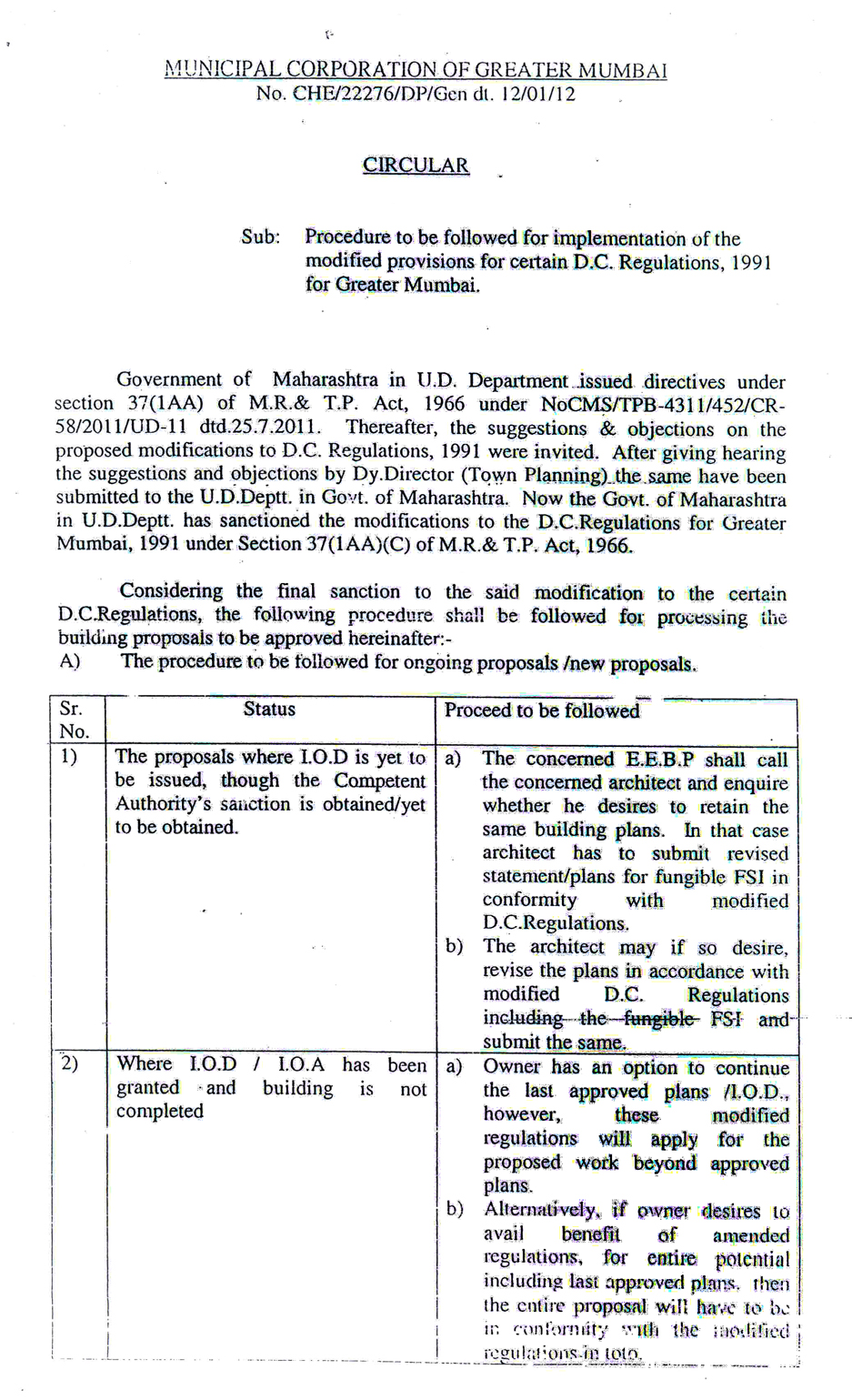
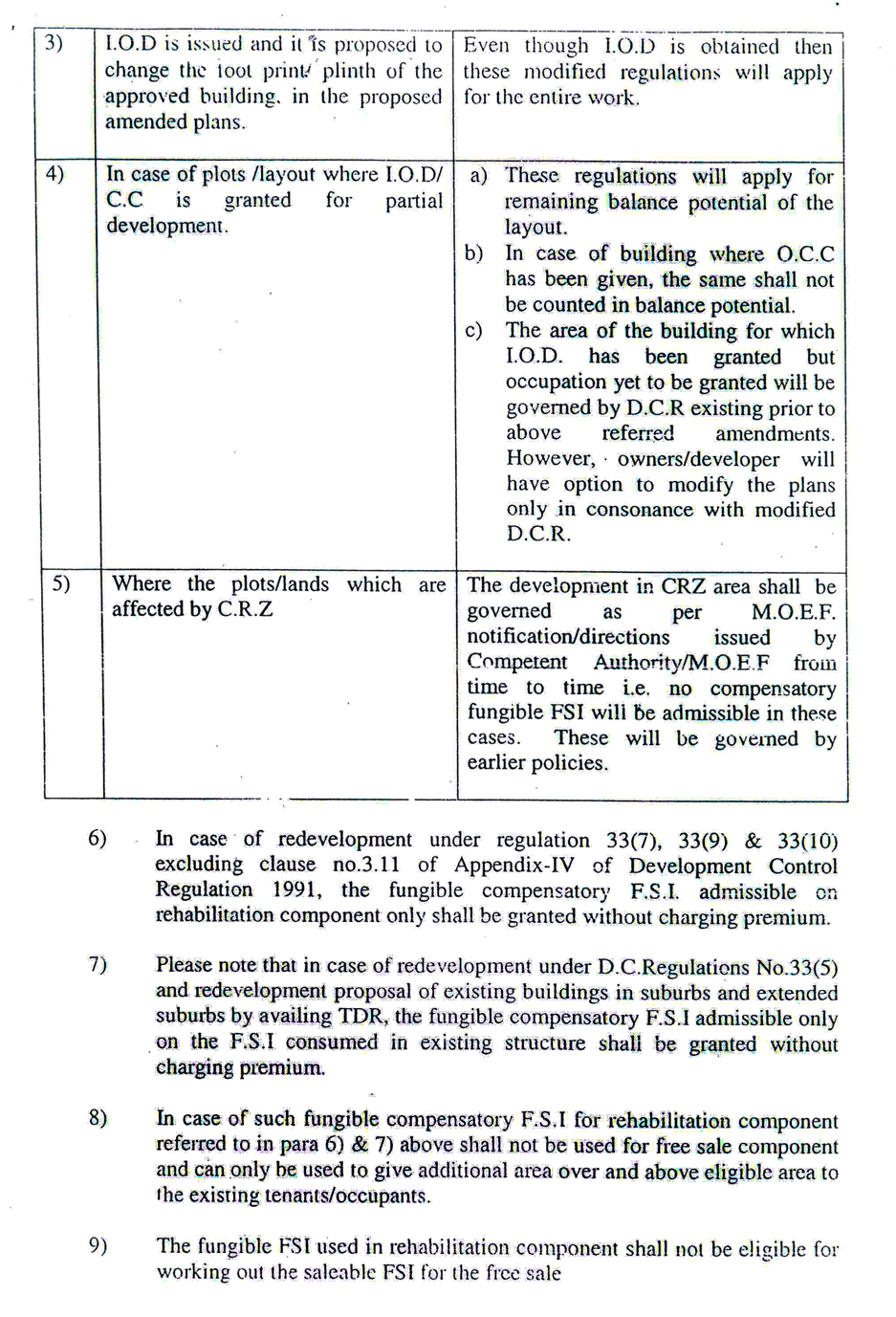
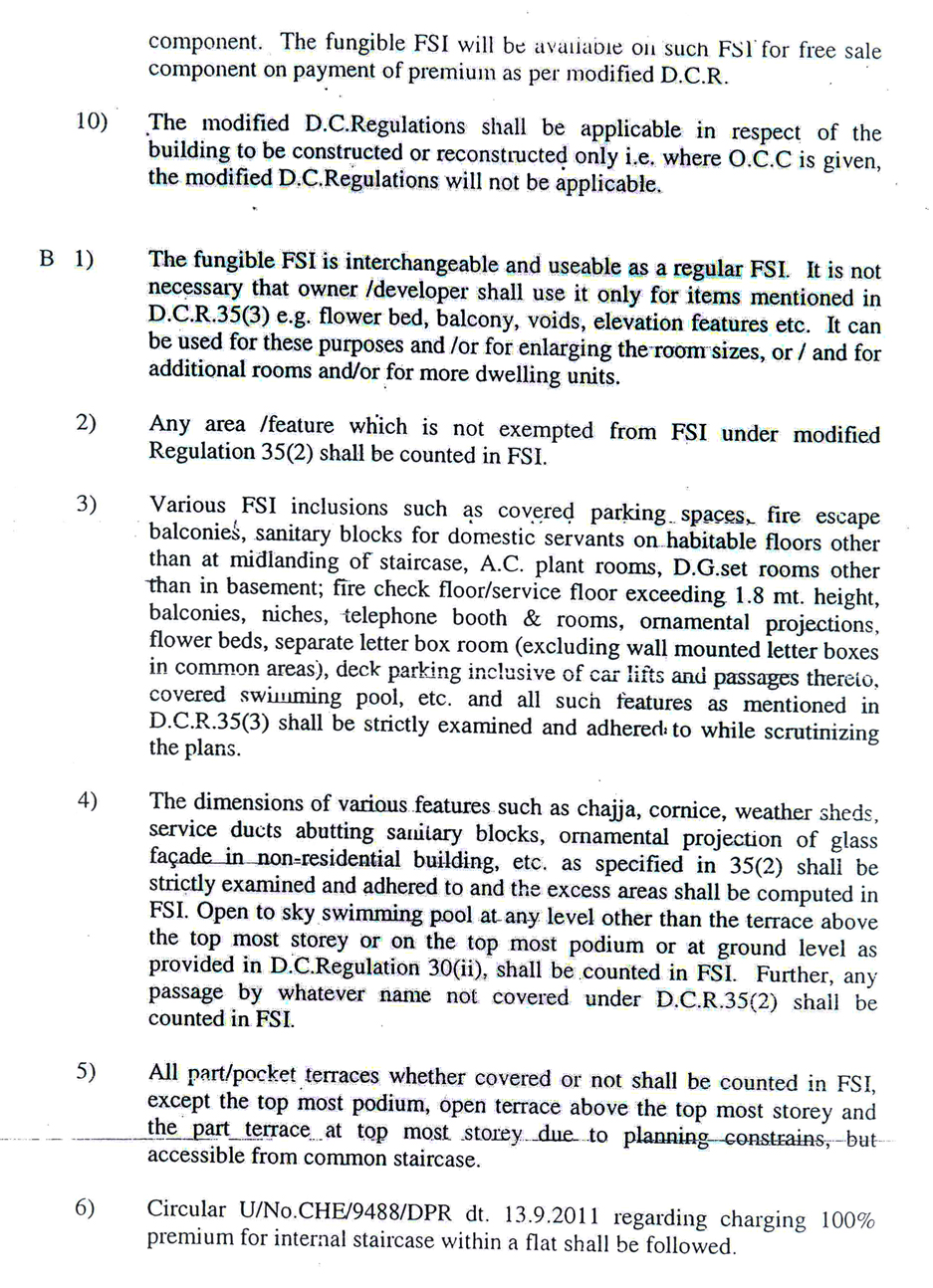
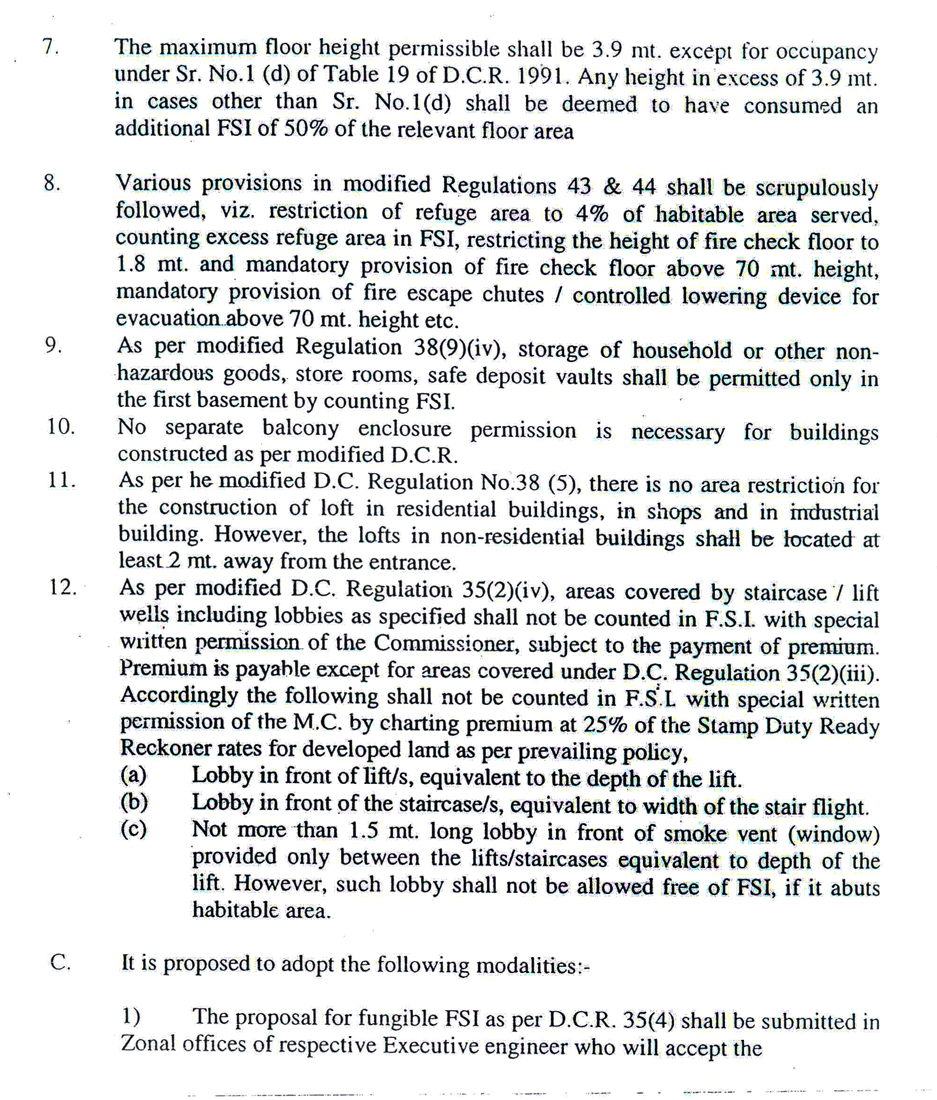
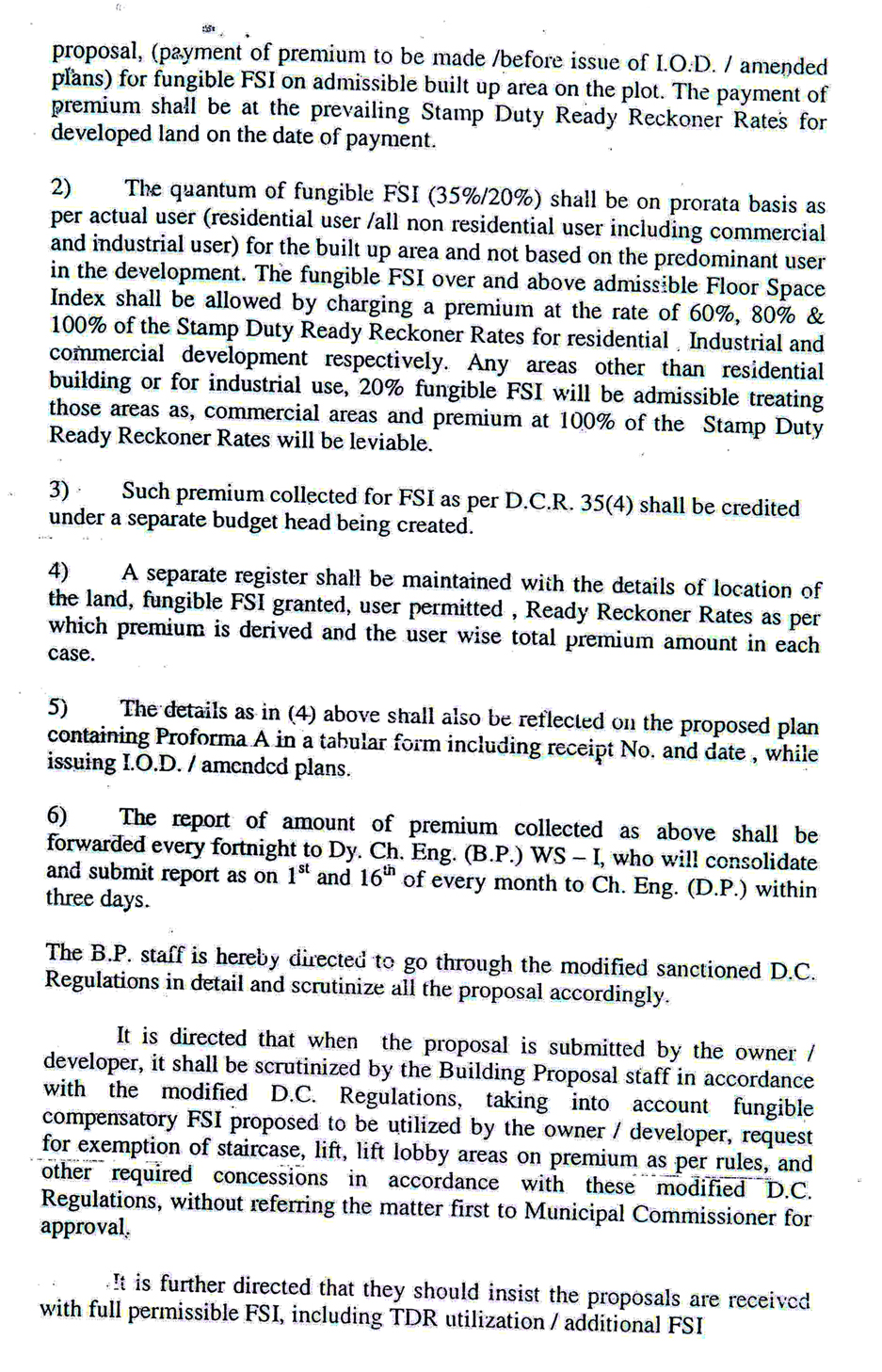
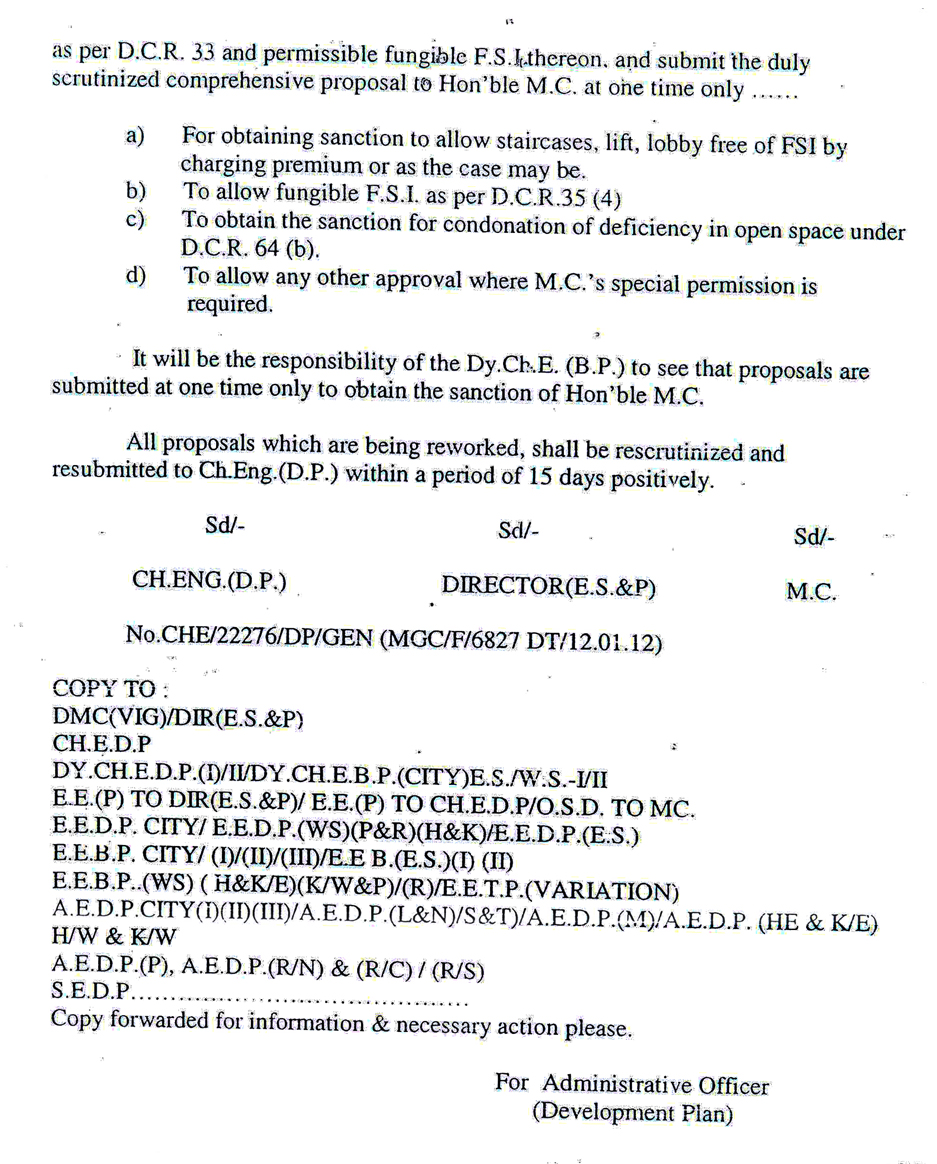
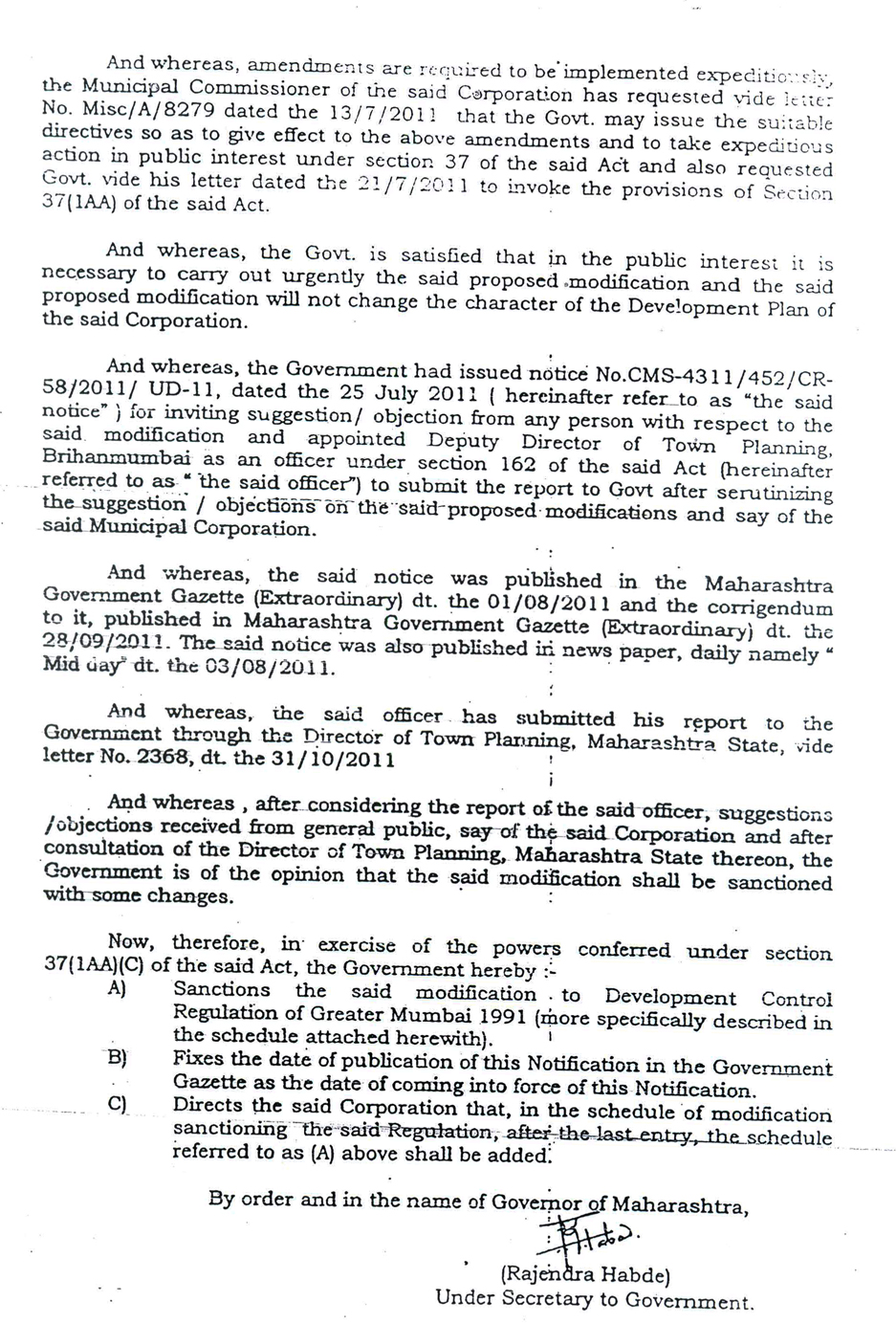
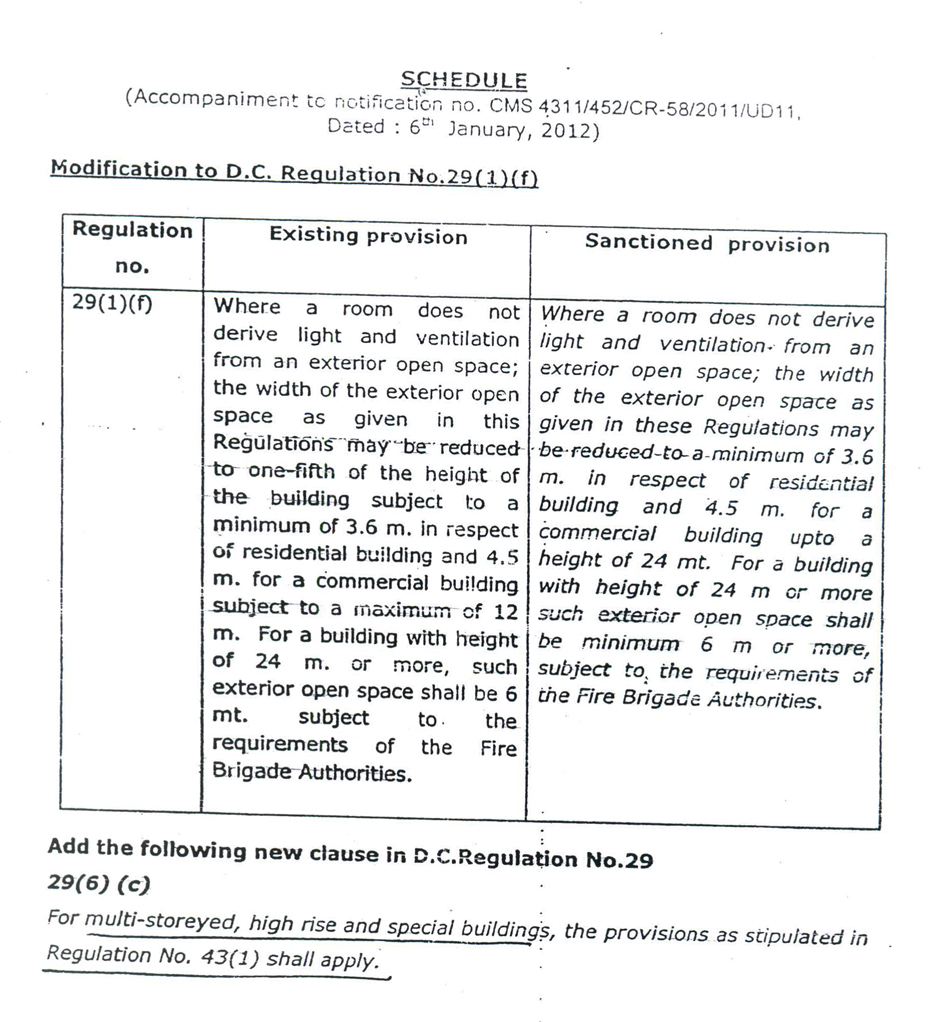
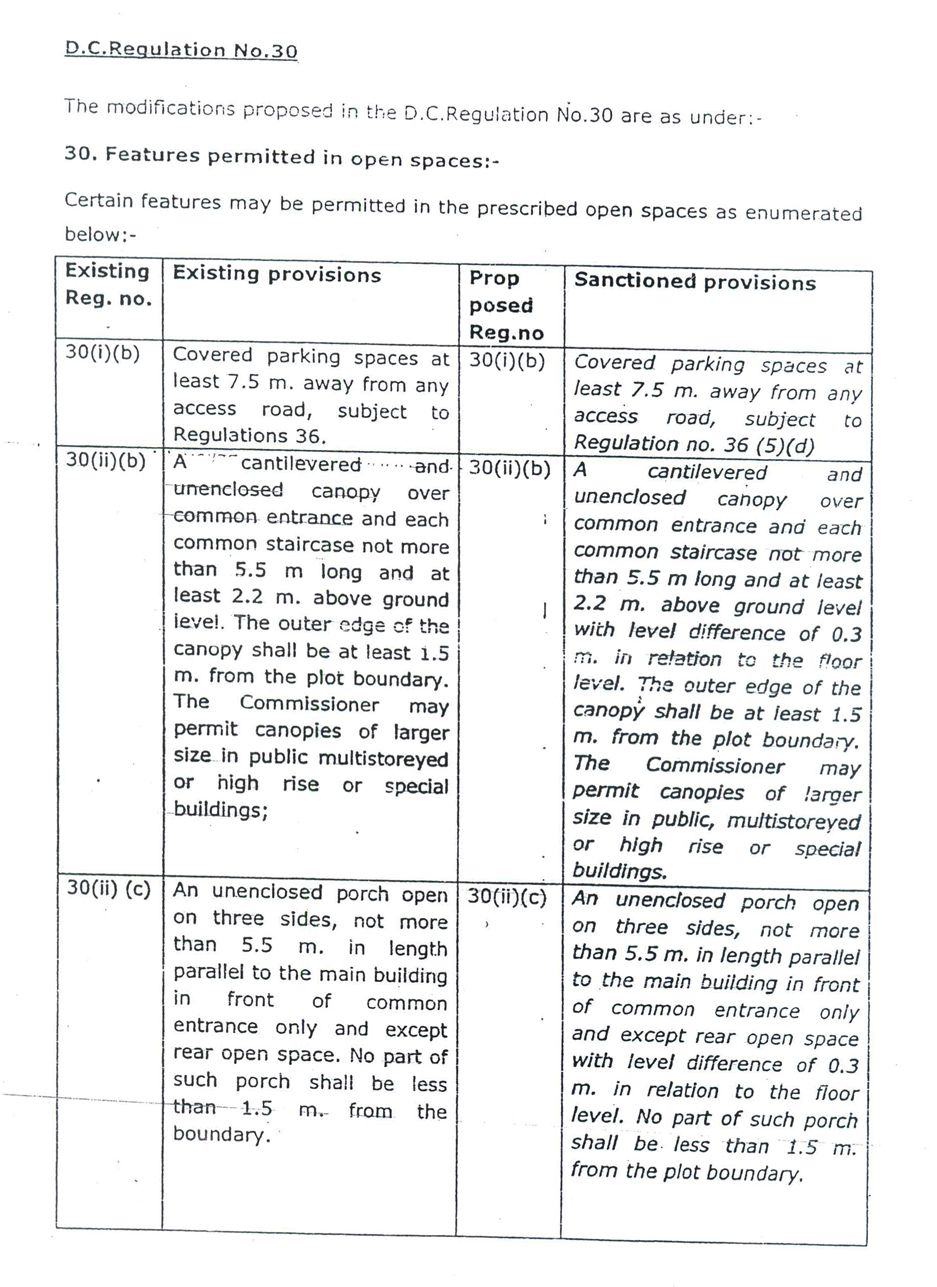
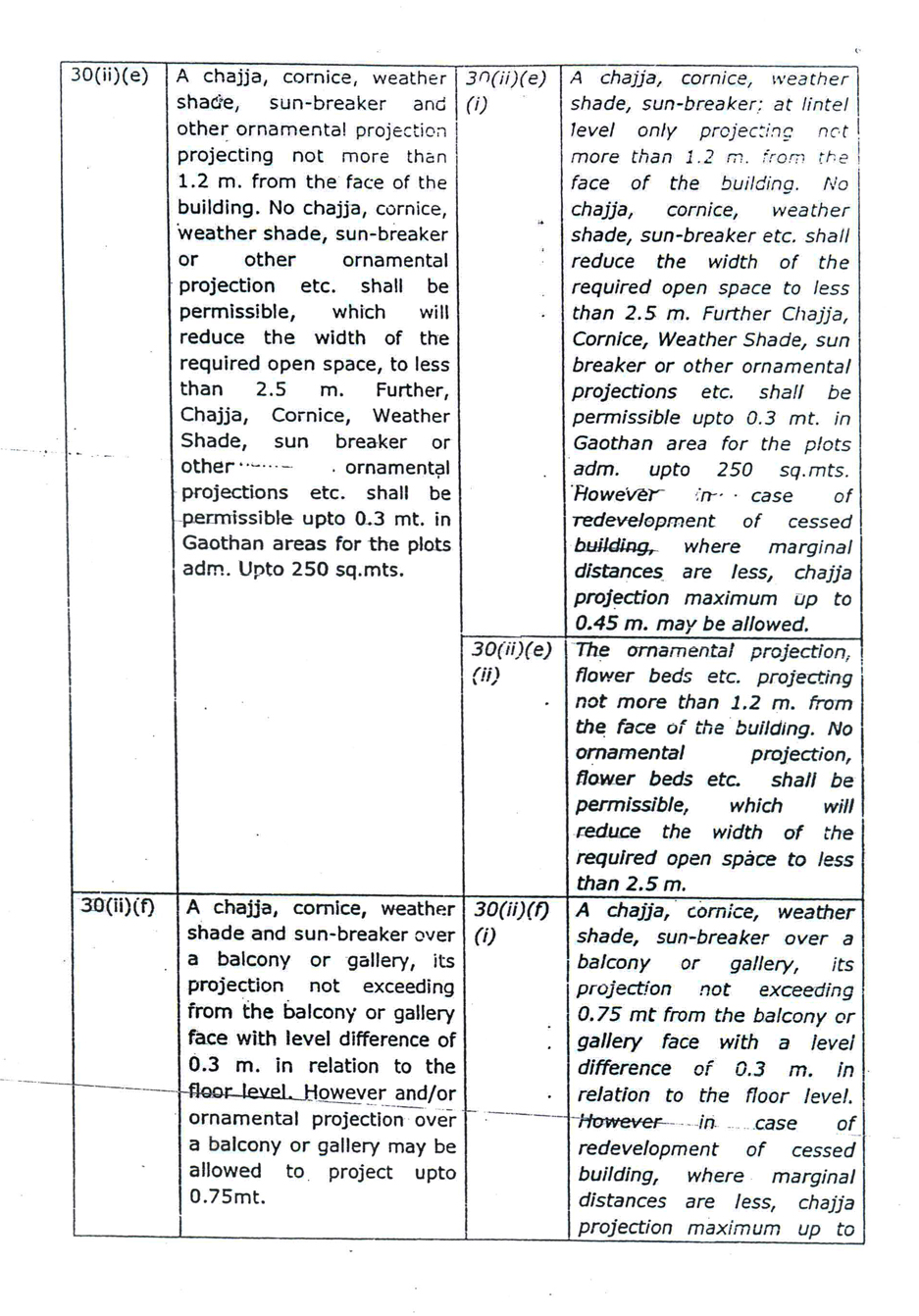
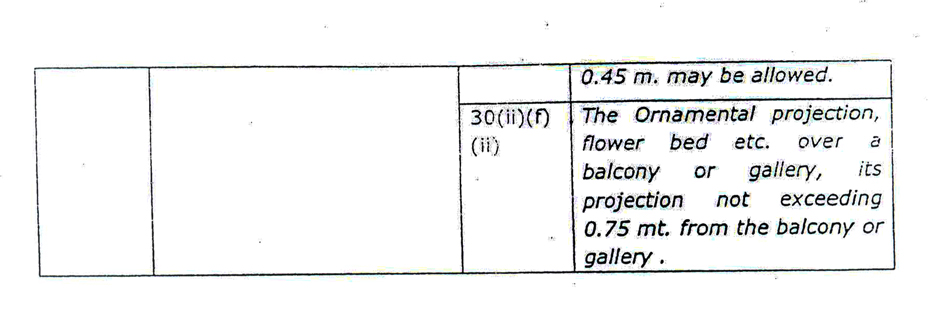
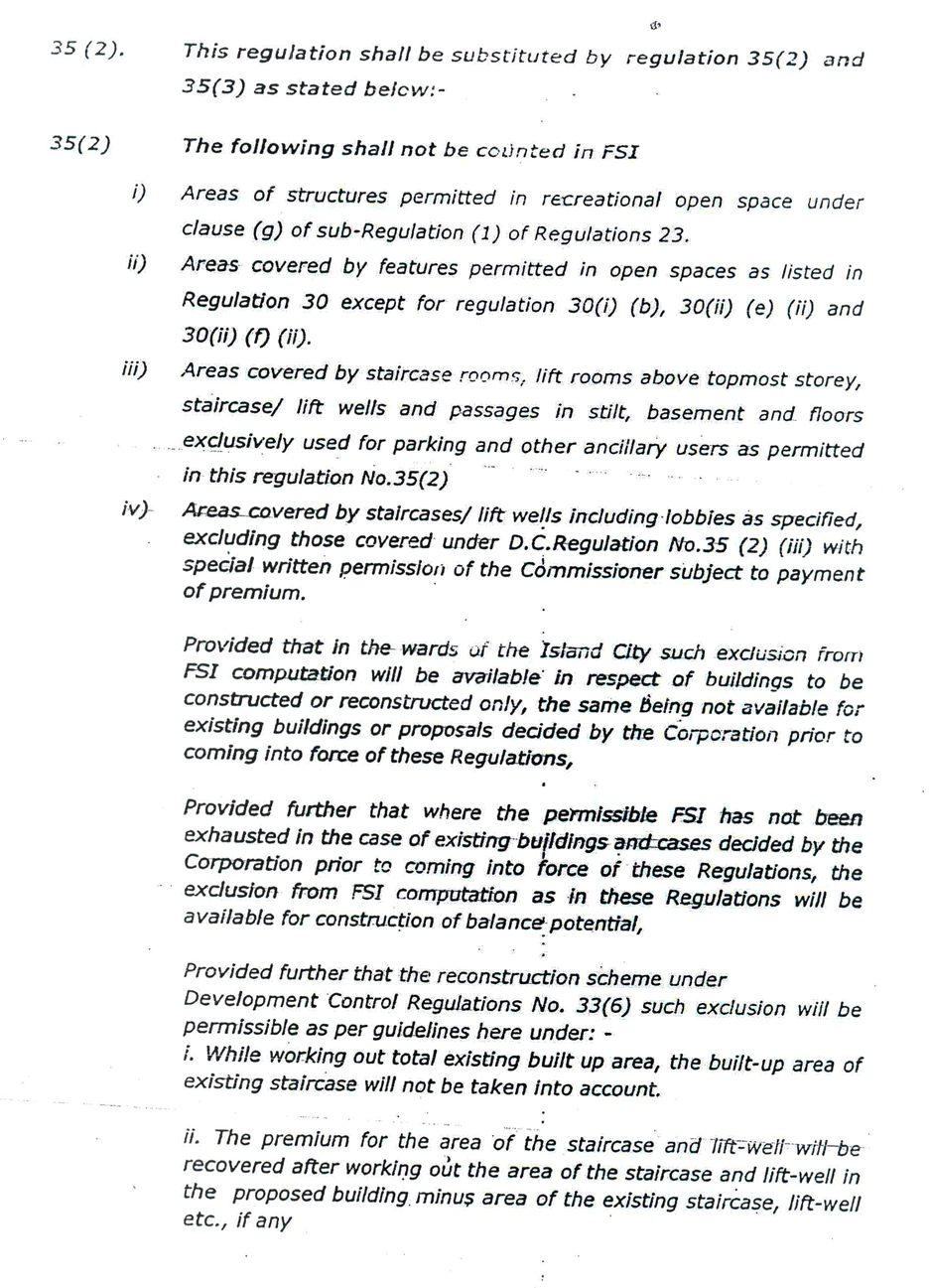
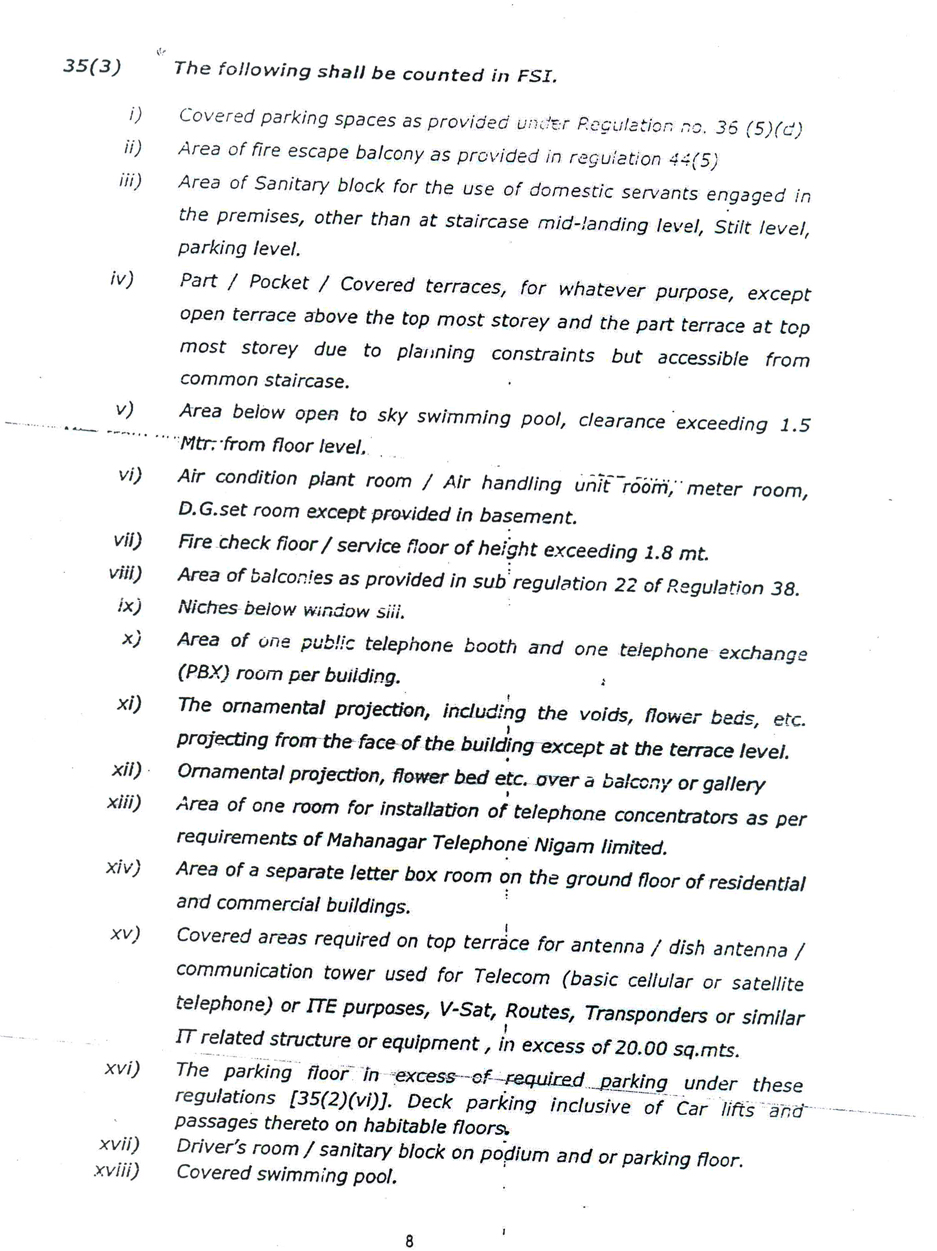
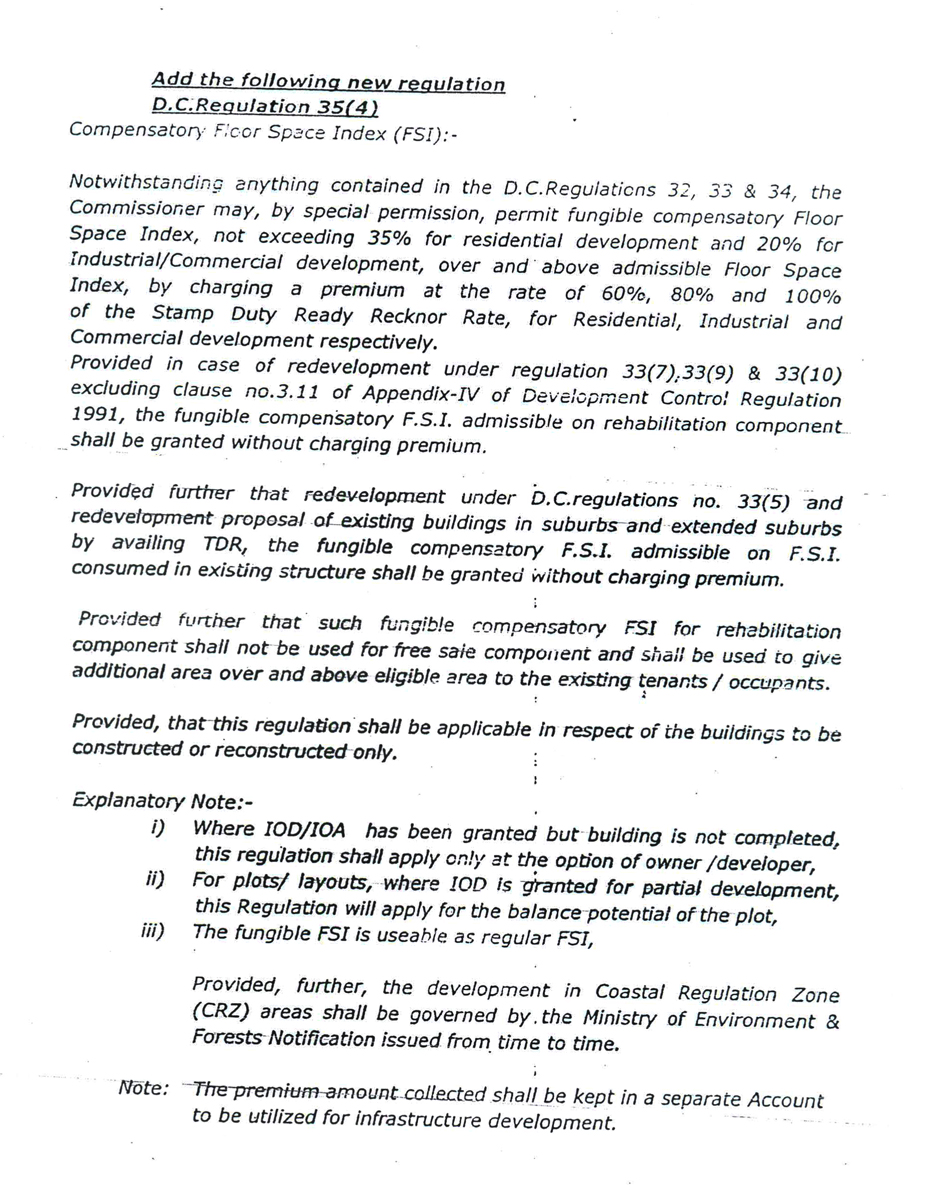
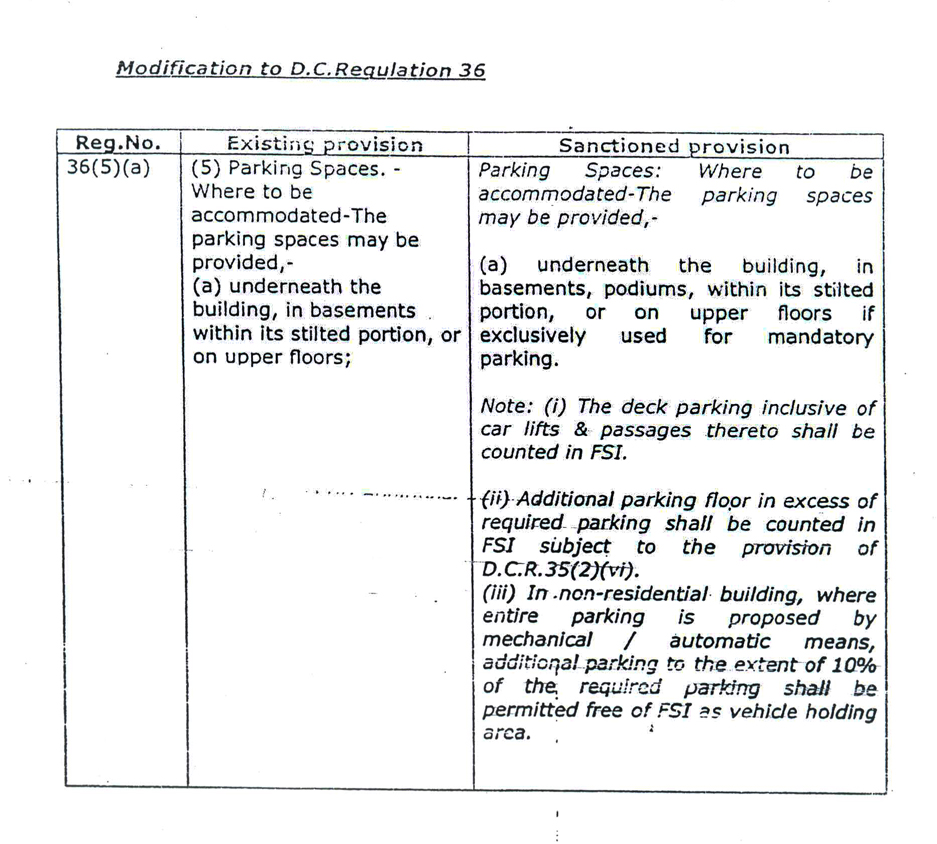
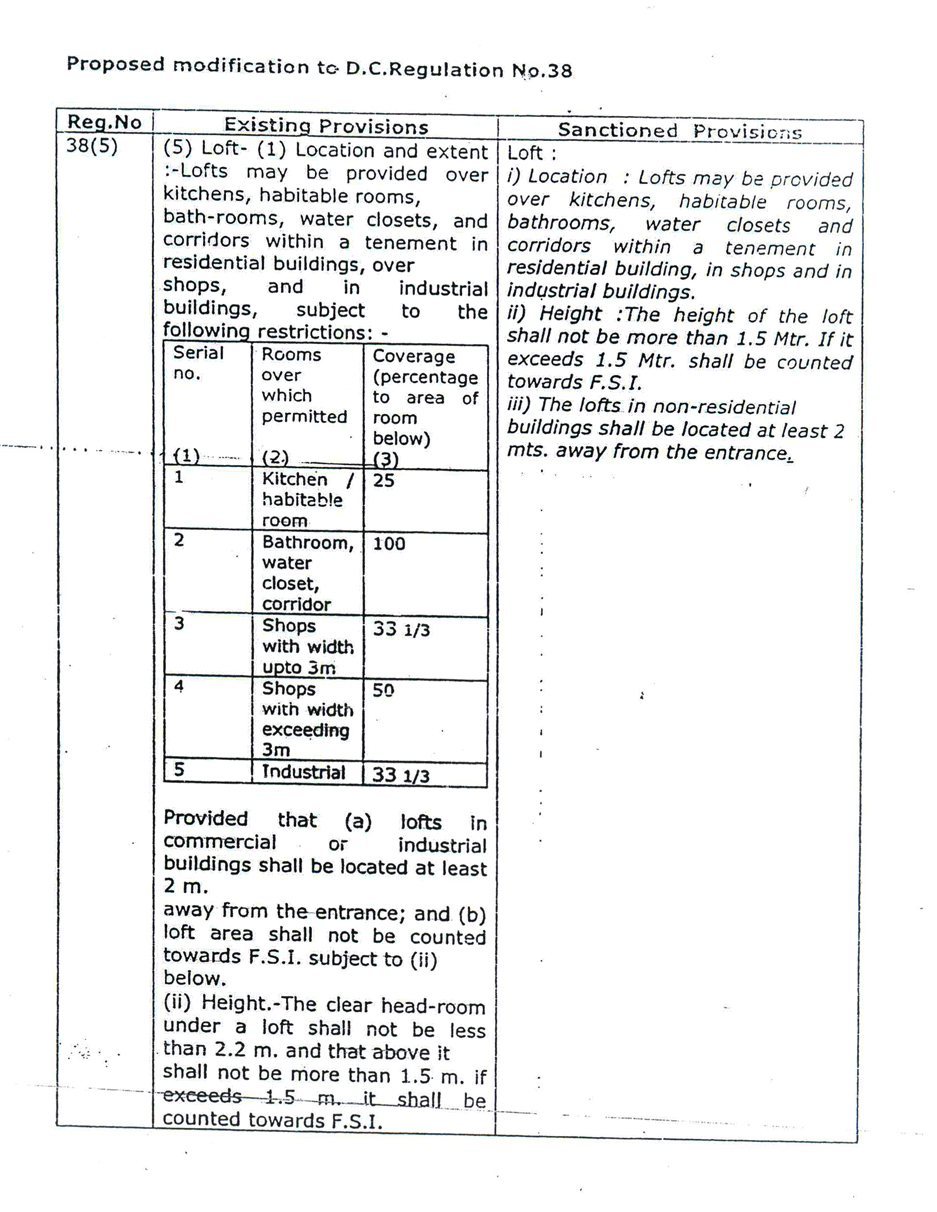
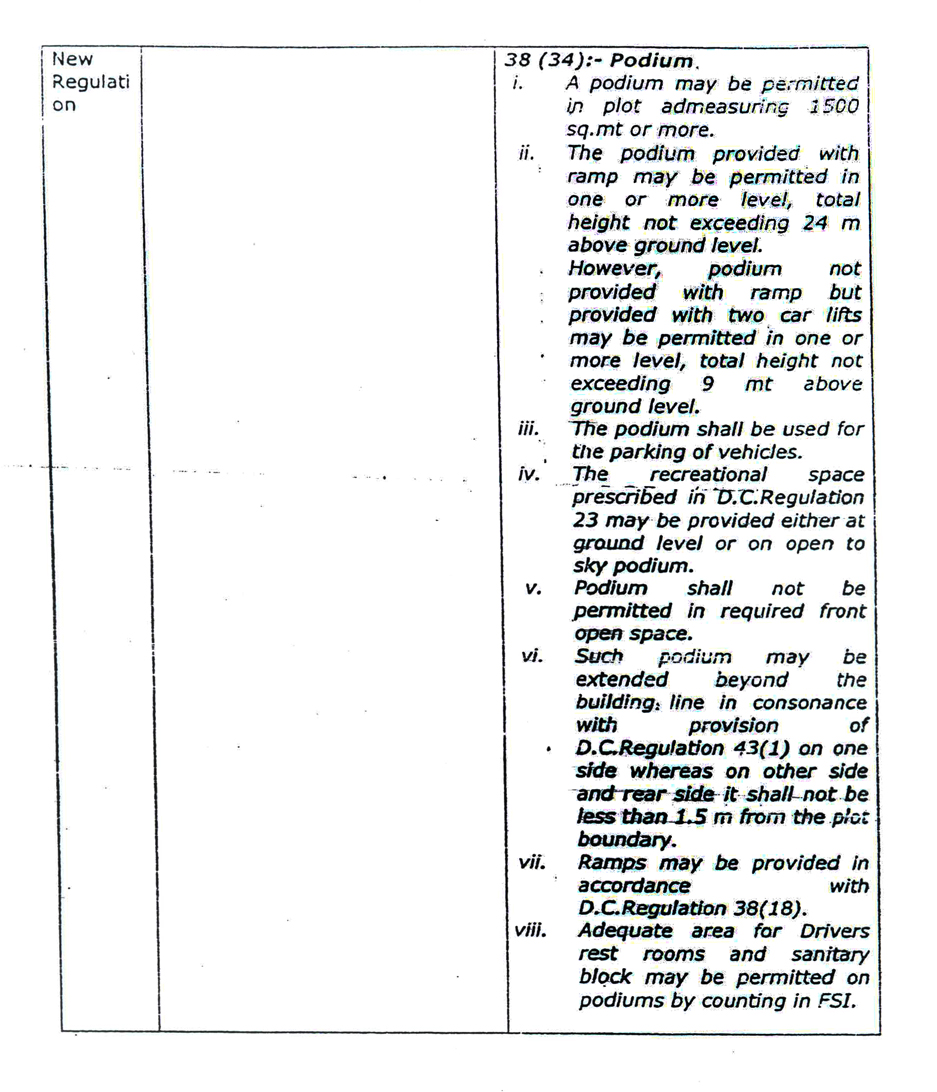
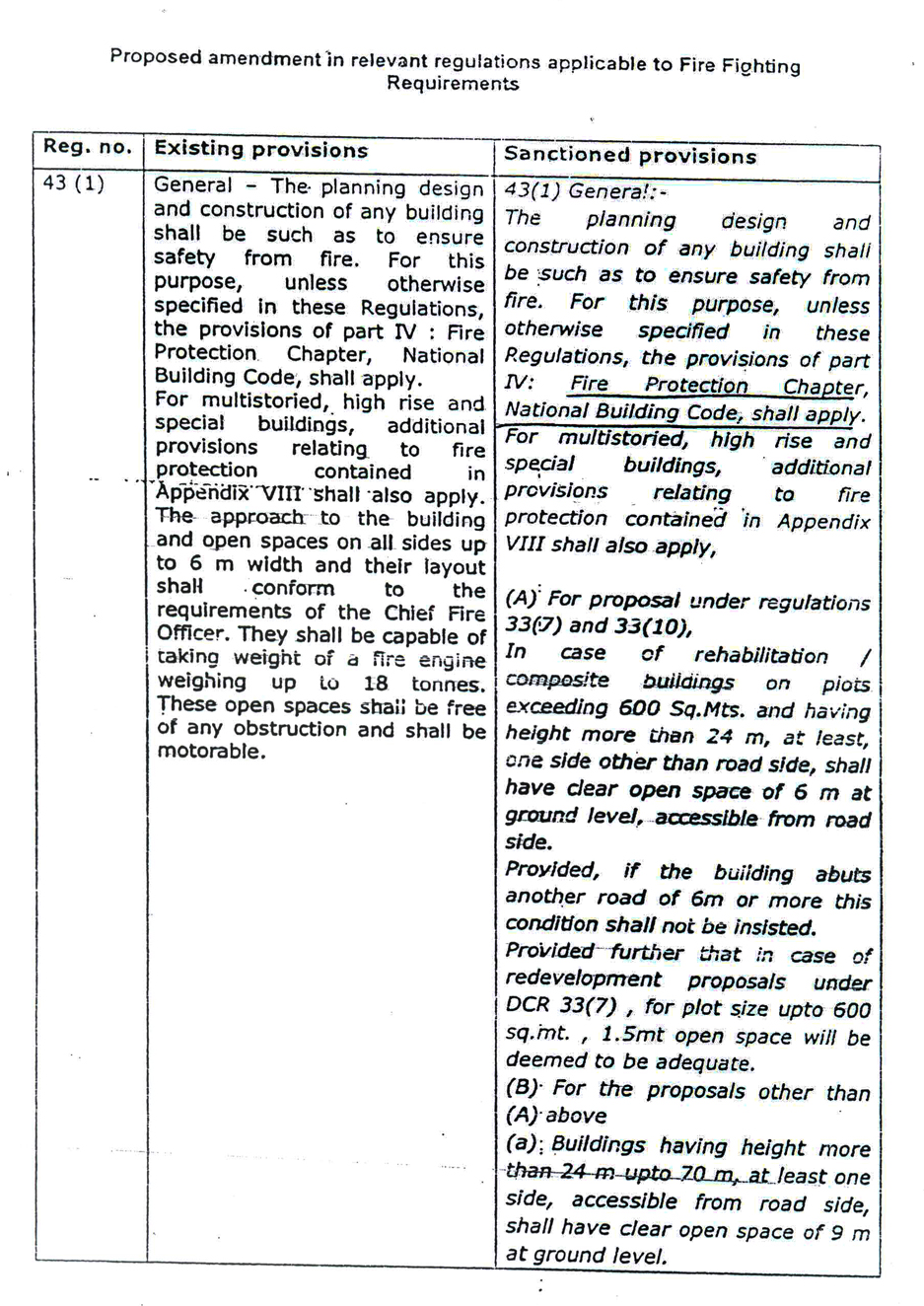
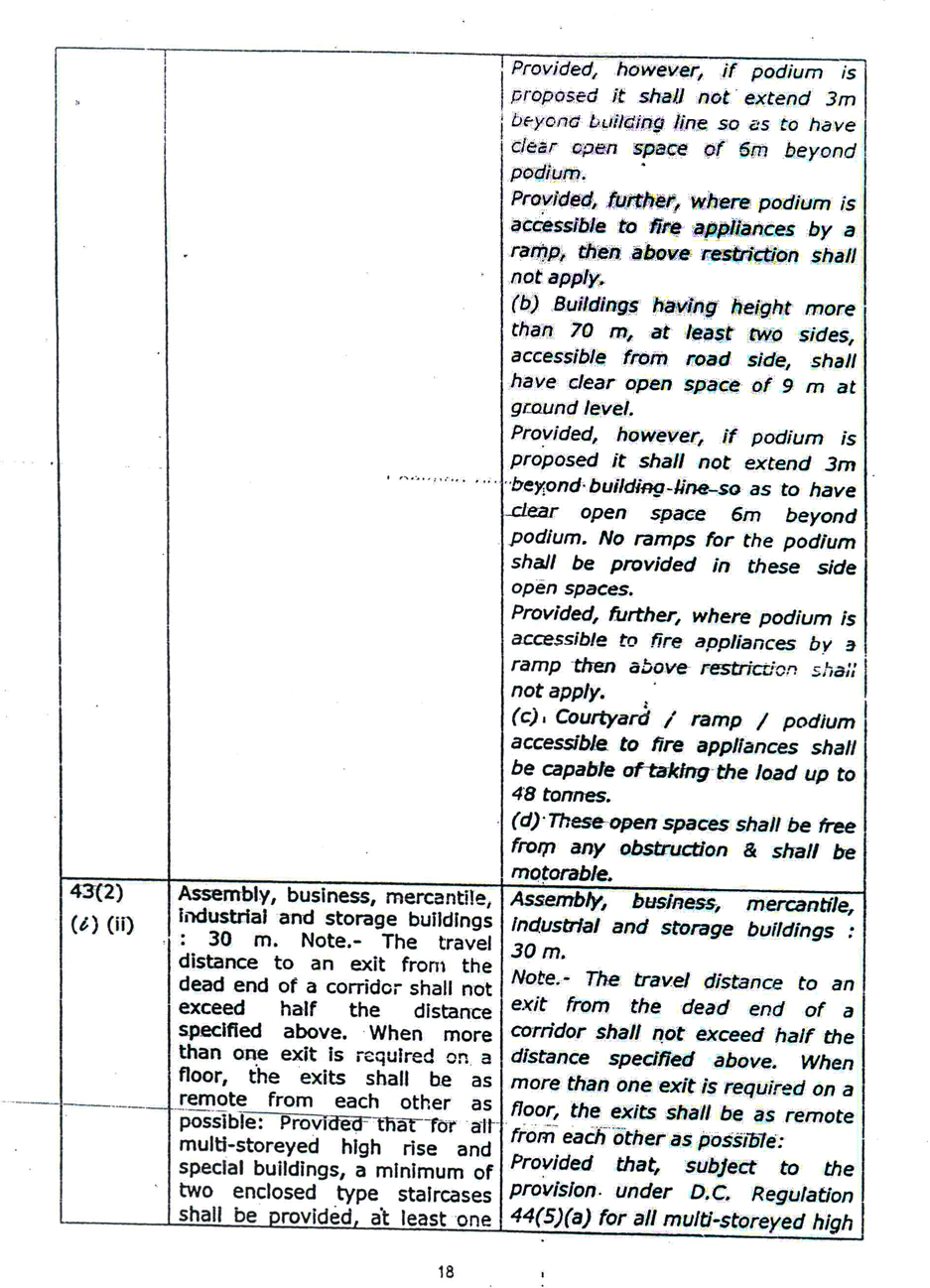
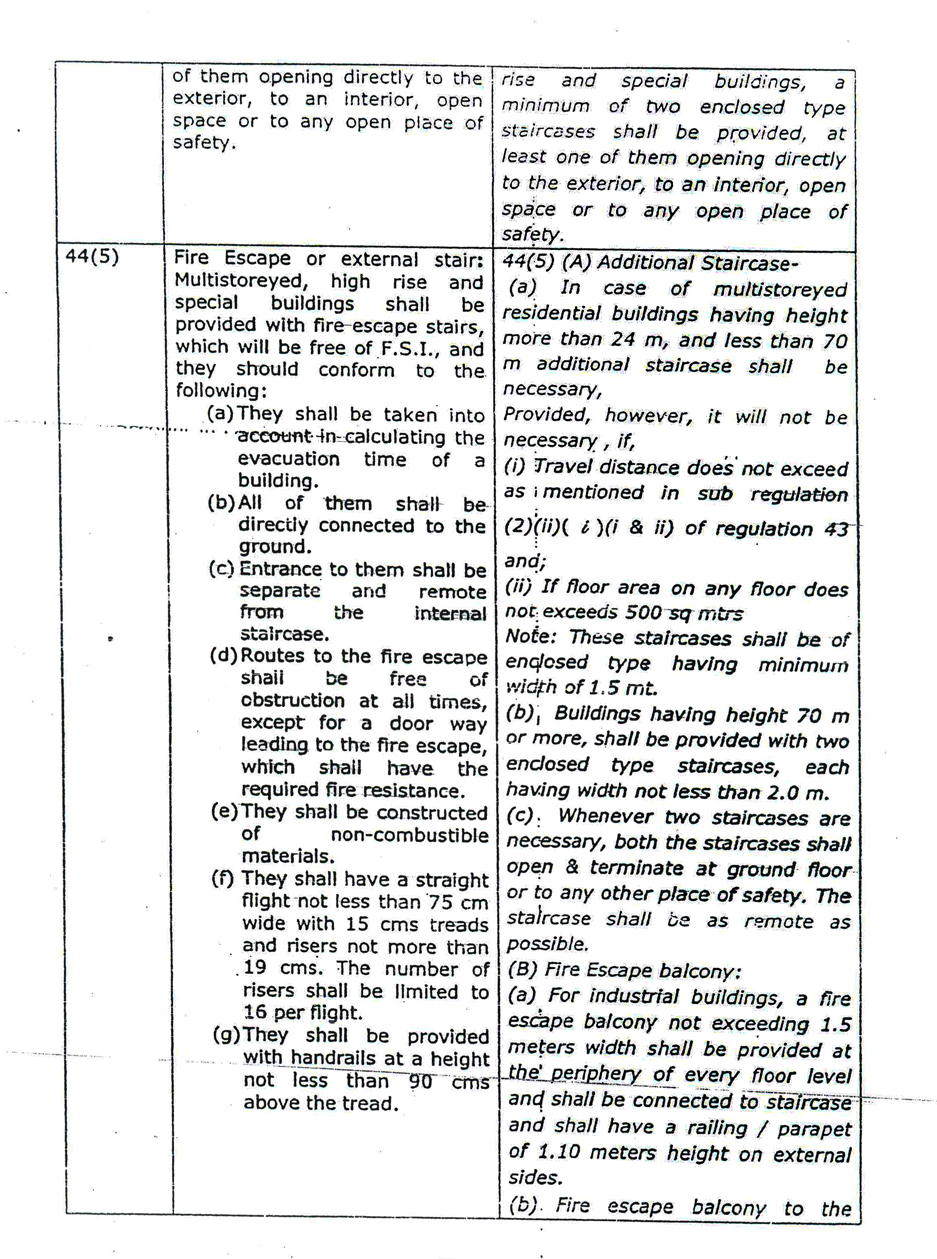
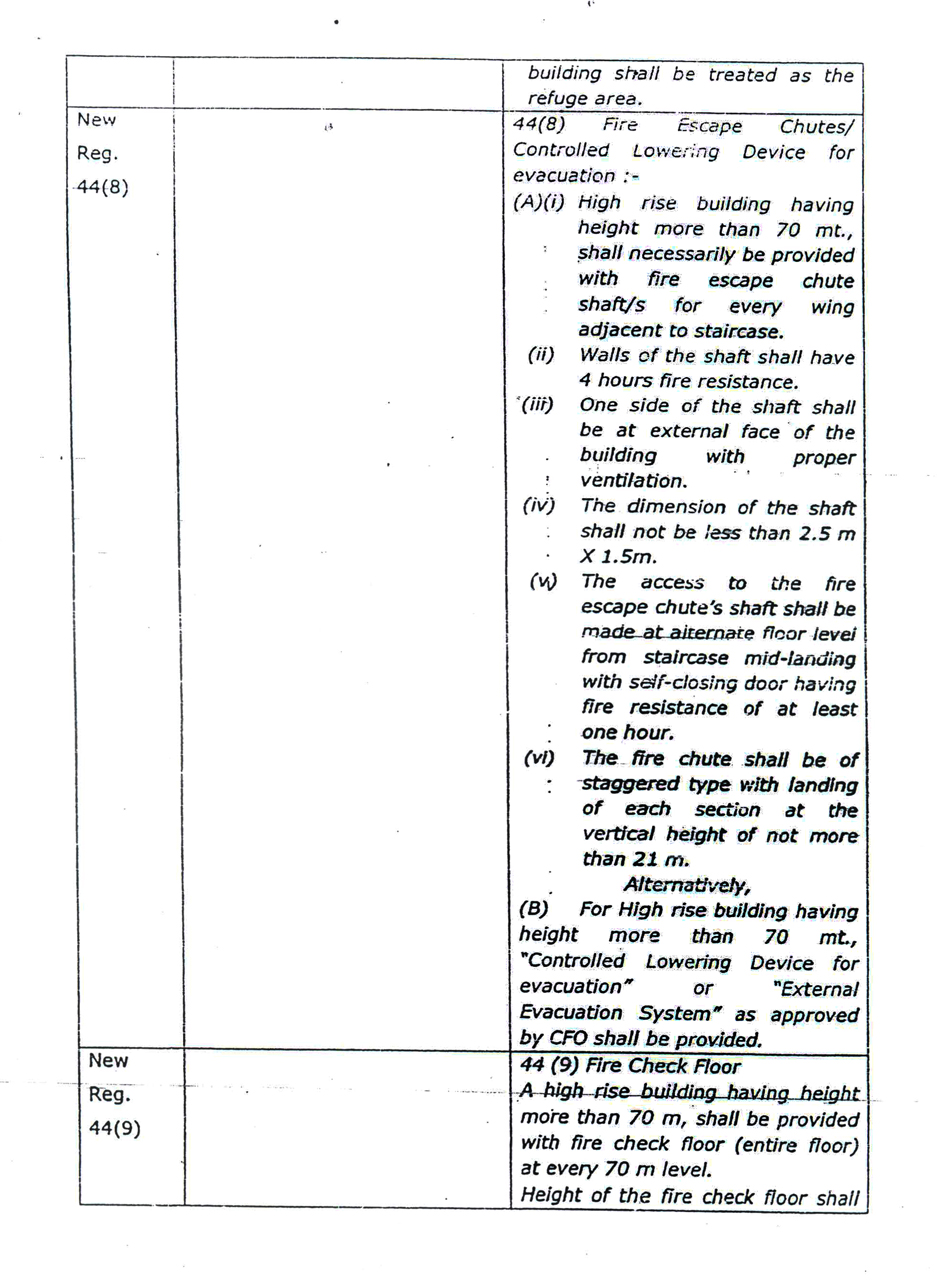
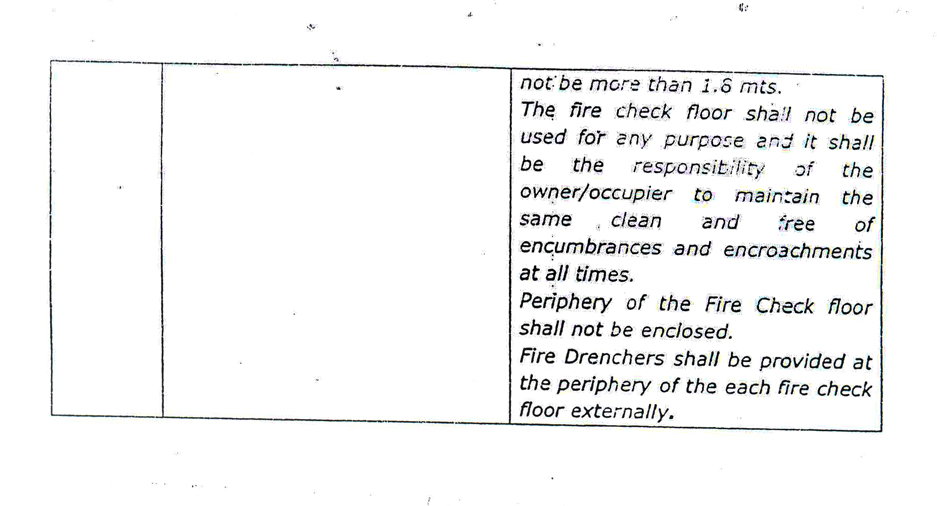
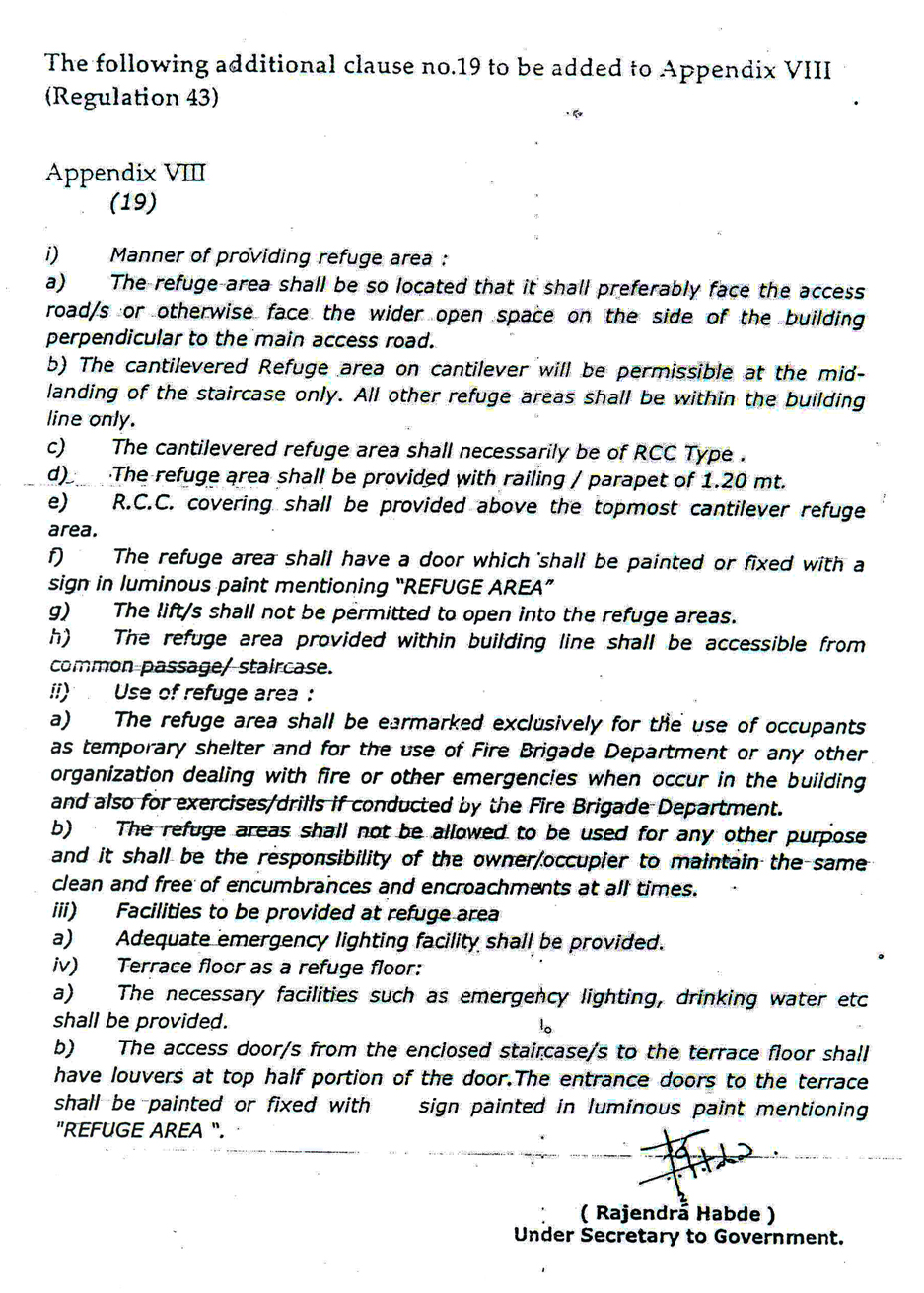
BMC Notification Dated 12th January, 2012 on New DC Regulations (click on the image)Click on the image
FSI Norms for Cluster Redevelopment in SuburbsCluster redevelopment under Development Control Rules i.e. DCR - Sect. 33(9) is a form of land development where principal buildings and structures are clubbed together on a site for redevelopment and a major portion of the site is left open for recreation and infrastructural facilities. The State Government has unveiled a new housing policy for Mumbai’s Suburban Regions which are now set for a massive makeover with paving the way for redevelopment of unsafe tenanted buildings, old colonies, transit camps and dilapidated MHADA colonies, with a slew of incentives with a permissible FSI of up to 4 under the Provisions of Sect.33(9) of DCR. In a reprieve for the State Government, the Bombay High Court had vacated a stay in the year 2017 granted on allowing increase in Floor Space Index (FSI) for new buildings proposed to be constructed in Navi Mumbai under the State's Cluster Redevelopment Scheme. The main catch is that while the minimum requirement to get a project under cluster redevelopment is 4,000 sq. mtrs in the Island city, the eligibility criteria for Mumbai Suburbs and extended Suburbs under the scheme has been enormously hiked to 10,000 sq. mtrs. However, the said scheme of cluster redevelopment, framed in 2009 as an Urban Renewal Scheme, redrafted in 2014, does not have a single success story to its name. Its success remains in question since this scheme has been a slow starter with many hurdles in the Island City since the last decade. It seems that the simultaneous implementation under DCR 33(7) for a singular tenanted building and DCR 33(9) for a cluster redevelopment has clearly conflicted with each other. The first project of cluster redevelopment covering 6.75 acres in Lalbaug area of Mumbai City Region to have taken off is still mired in red-tape and faces the threat of being abandoned. Another example is of Saifee Burhani Upliftment Project which is undertaking over a massive area spread across 16.50 acres at Bhendi Bazaar. The said project is currently struggling to convince approximately 600-700 tenants out of 6,000 tenants to move out of the premise. These tenants now fear that their dream of living in a decent dwelling may turn into a nightmare as the structures they are living in are beyond their age to sustain any mishap and any further delay in redeveloping them could prove disastrous. This kind of scheme requires lot of patience and finance as also a handful of tenants can derail the entire project. With the current market slump, it is very difficult for any Developer to undertake an area of 10,000 sq. mtrs for redevelopment and obtain the consent of hundreds of flat owners living there besides this; there are planning constraints, no proper approach road or no proper access to the plot. Under such a situation, it becomes critical that a cluster approach is adopted as it involves the amalgamation of plots for organised development. It may be noted here that the unauthorized constructions are not to be taken in account while computing FSI.
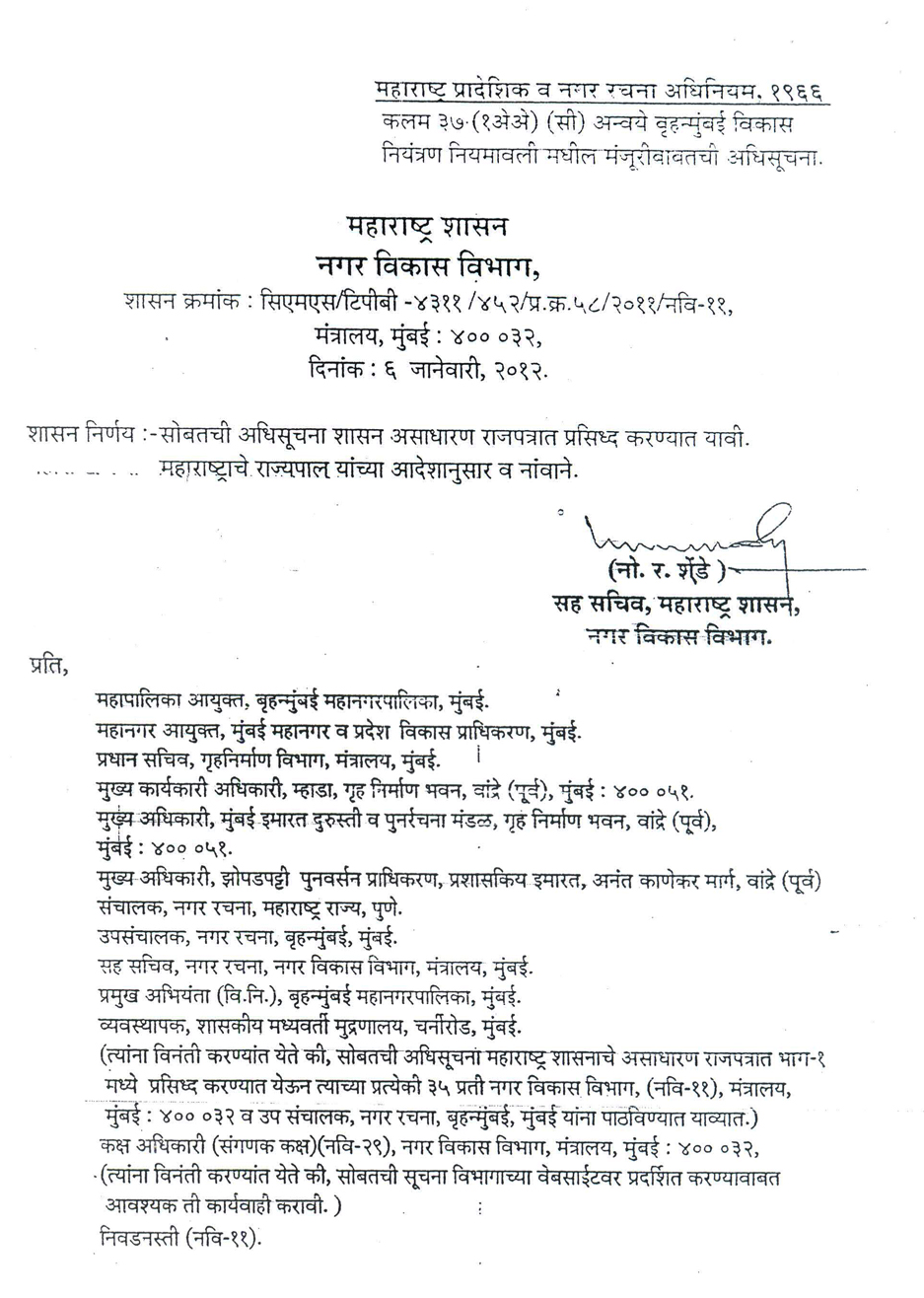
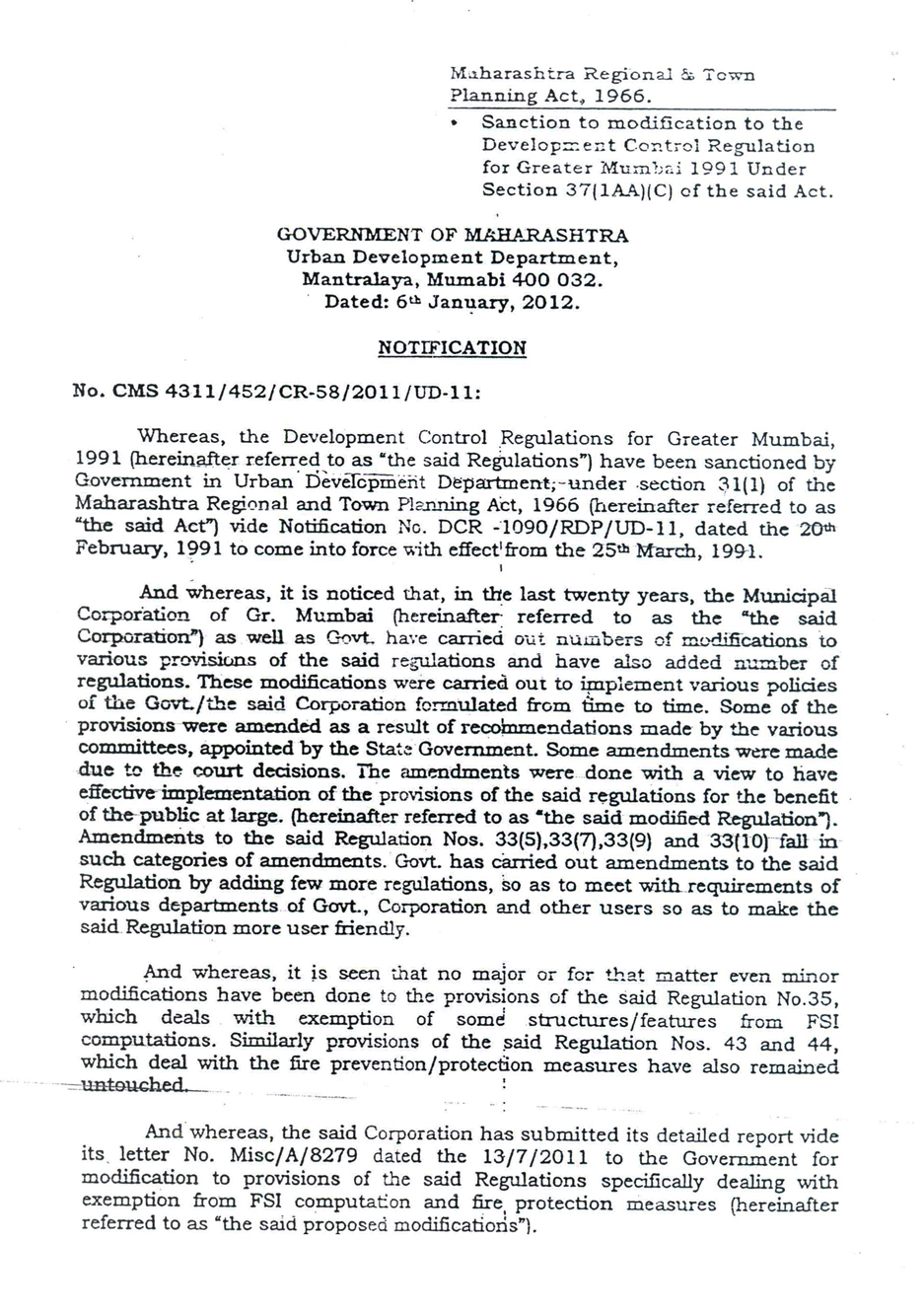
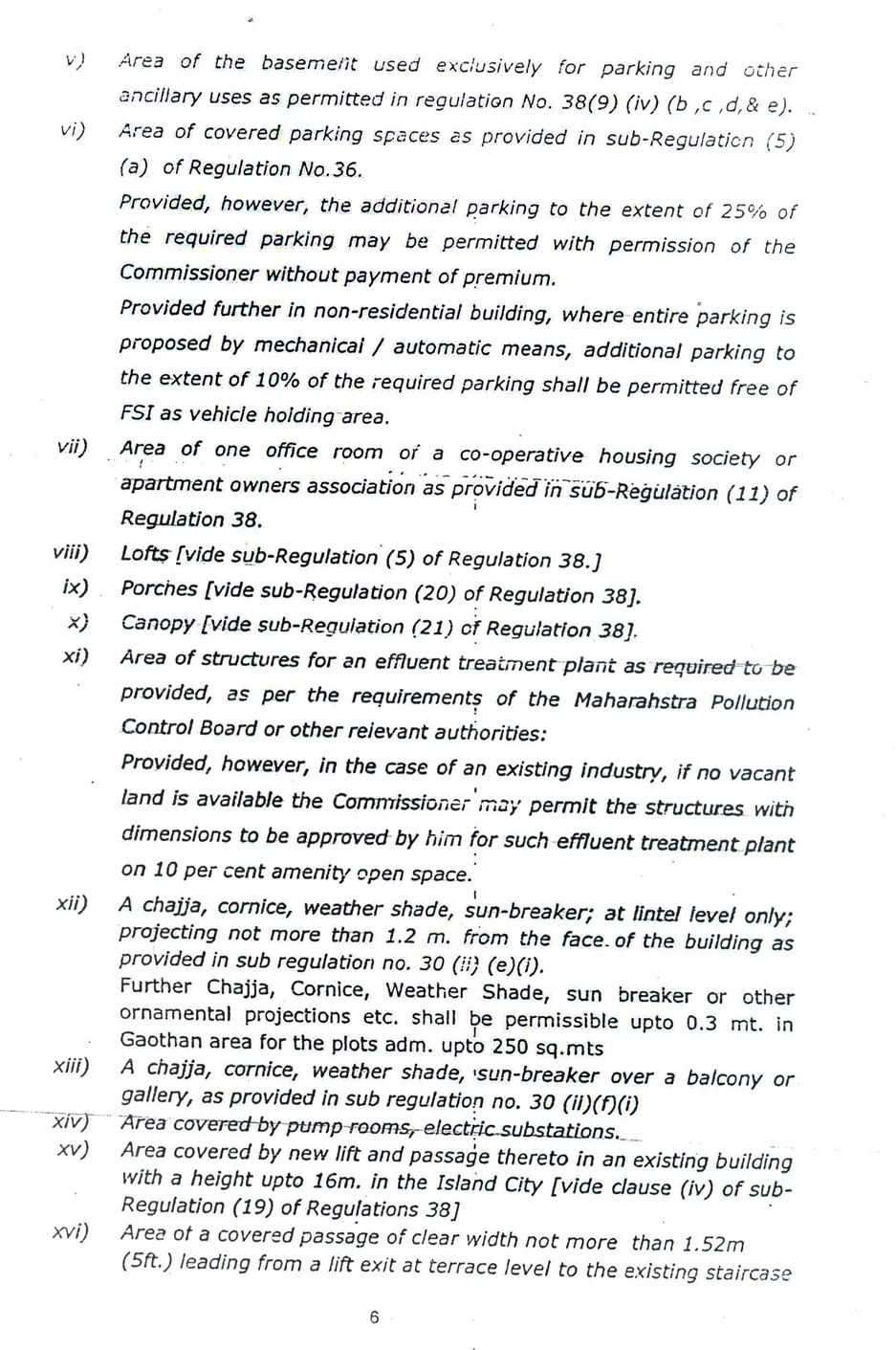
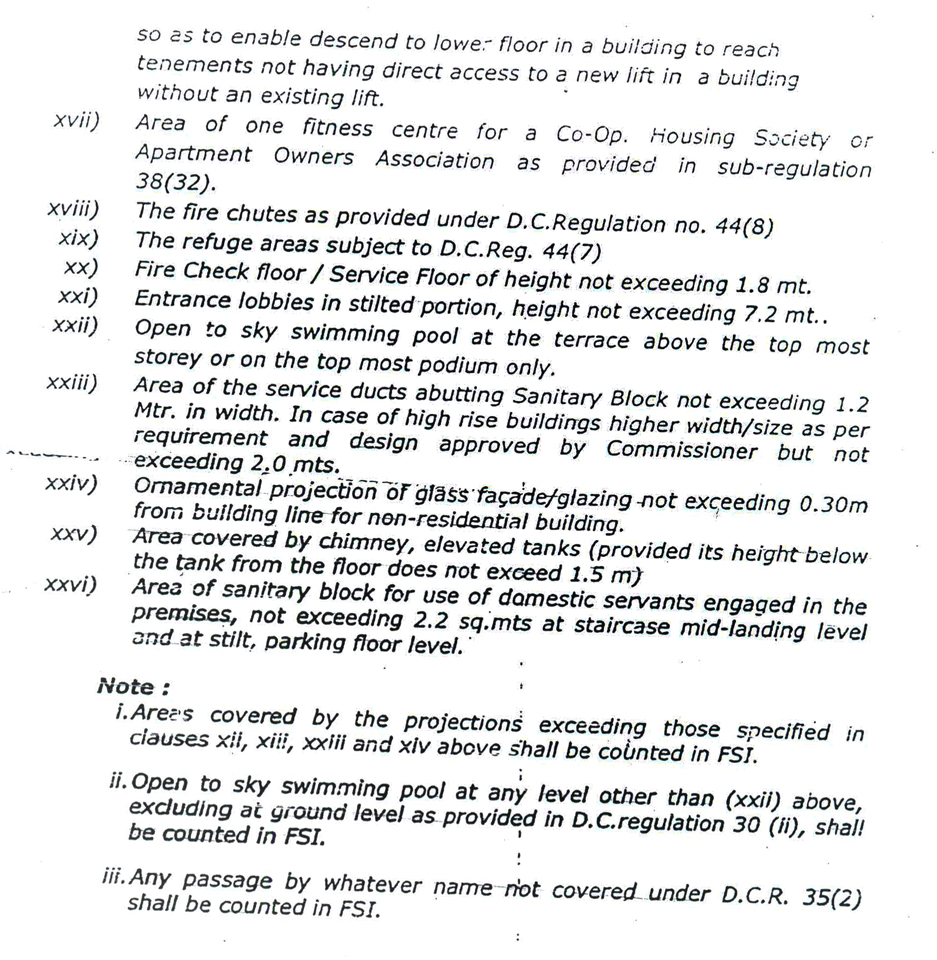
********************** Govt. Notification Dated 6th January, 2012 on New DC Regulations (click on the image)Click on the image
|
|